
Reptile Enclosure Size Guide: Tank Sizes by Species, With Sources
Affiliate disclosure: product links on this page go to Amazon, or to the maker's own store for brands that sell only direct. As an Amazon Associate we earn from qualifying purchases, at no extra cost to you; a link to a maker's store earns us nothing. No retailer or brand sees our picks before they are published or has any say in them. How we choose.
The short answer: published minimums for one adult of the six species most US keepers start with run from a 10-gallon tank for a leopard gecko to about 12 square feet of floor for a large bearded dragon or blue-tongued skink, and the sources disagree by a factor of two or more. If you want one size that meets every source we read for an adult, it is a 36 x 18 inch floor (4.5 square feet) for most leopard geckos, 48 x 24 inches (8 square feet) for a ball python or corn snake up to 4 feet long, and 72 x 24 inches (12 square feet) for an adult bearded dragon or blue-tongued skink. Crested geckos climb, so height comes first: the RSPCA minimum is 45 x 45 x 60 cm, about 18 x 18 x 24 inches.
There is no US legal minimum enclosure size for pet reptiles. The federal Animal Welfare Act defines the animals it covers as dogs, cats, listed mammals "or such other warm-blooded animal" (7 U.S.C. 2132(g)), which leaves reptiles out. Every figure below is veterinary or welfare guidance, except one set that is law in New South Wales, Australia, and each names its source.
Enclosure size by species
The table lists each species' adult length and the minimum each source sets for one adult. Floor areas are in square feet (1 square meter is 10.76 square feet). The Merck Veterinary Manual gives formulas rather than sizes (0.2 square meters of floor per 10 cm of a terrestrial lizard's total length, 0.6 square meters per meter of a python or rat snake, 0.4 cubic meters per 10 cm of an arboreal lizard), so we worked them through for the adult lengths in the second column.
| Species | Adult length (source) | Care sheet and legal minimums | Merck formula, worked through | Meets every source here |
|---|---|---|---|---|
| Leopard gecko | 7.1 to 7.9 in (females), 7.9 to 11 in (males) (San Diego Zoo) | VCA: 10-gallon tank, at least 6 in high (VCA). RSPCA: 60 cm long, 30 cm deep, 40 cm high, about 24 x 12 x 16 in (RSPCA) | 3.9 to 6.0 sq ft of floor | 36 x 18 in (4.5 sq ft) for most; 48 x 18 in (6 sq ft) for the largest males |
| Bearded dragon | 18 to 22 in (VCA) | VCA: 60 to 100 gallons or larger, length at least 3 times the lizard's total length (54 to 66 in), width at least 16 in (VCA). RSPCA: 120 x 60 x 60 cm, about 47 x 24 x 24 in (RSPCA). NSW law: 0.375 sq m (4.0 sq ft) of floor or back wall (NSW code) | 9.8 to 12.0 sq ft | 72 x 24 x 24 in (12 sq ft) |
| Ball python | 1 to 1.5 m, about 3.3 to 4.9 ft (Animal Diversity Web) | RSPCA: as long as the snake, with width and height at least one third of its length; a 120 cm snake needs 120 x 40 x 40 cm (RSPCA) | 6.5 to 9.7 sq ft | 48 x 24 x 24 in for snakes up to 4 ft; 60 x 24 in (10 sq ft) for a 5 ft snake |
| Corn snake | 70 to 120 cm average, about 2.3 to 3.9 ft (Animal Diversity Web); VCA gives 3 to 6 ft (VCA) | RSPCA: the same one-third rule; a 150 cm snake needs 150 x 50 x 50 cm, about 59 x 20 x 20 in (RSPCA) | 4.5 to 7.8 sq ft for 70 to 120 cm | 48 x 24 x 24 in for snakes up to 4 ft |
| Crested gecko | About 8 in (20.3 cm) total (Animal Diversity Web) | RSPCA: 45 cm wide, 45 cm deep, 60 cm tall, about 18 x 18 x 24 in (RSPCA) | About 0.81 cu m (28.7 cu ft) of volume | 18 x 18 x 24 in meets the RSPCA minimum; see the note below on Merck |
| Blue-tongued skink | About 17 in average, up to 22 in (Smithsonian's National Zoo) | NSW law: 0.375 sq m (4.0 sq ft) of floor, measured outside (NSW code) | 9.7 to 12.1 sq ft | 72 x 24 in (12 sq ft) for all but the largest |
Two rows need a comment. For bearded dragons, a 4 x 2 x 2 foot enclosure meets the RSPCA and NSW minimums but not VCA's three-times-length rule or the Merck formula, which is why the right-hand column says 6 feet. For crested geckos, the Merck figure for arboreal lizards, taken literally, is about 1.8 times the volume of a 2 x 2 x 4 foot enclosure (16 cubic feet). We report it because it is the manual's number, but no other source we read comes close to it, and the manual's table cites no source of its own.
Why the sources disagree
They answer different questions. VCA's and the RSPCA's care sheets set a practical minimum for one pet, and both add that more is better: the RSPCA says a leopard gecko's enclosure "should be as large as possible." The Merck Veterinary Manual tells owners to provide "the largest enclosure possible" and scales its minimums to the animal's length. The New South Wales code is a legal floor for licensed keepers, measured on the outside of the enclosure, and it says its figures are "based on the average length" and that larger individuals "should be housed in a larger enclosure."
For snakes the debate is about stretching out. In a review and observation study, Warwick, Arena and Steedman (Journal of Veterinary Behavior, 2019) watched 65 captive snakes for 60 minutes each and recorded 24 of them (37%) in straight or near-straight postures, and concluded that snake husbandry needs to recognize "the greater spatial needs of these reptiles." The RSPCA's rule that the enclosure be at least as long as the snake follows the same idea.
Gallons, inches and what the label means
Gallon labels are volume worked out from the outside dimensions. A US gallon is 231 cubic inches (NIST Handbook 44, Appendix C), so a 48 x 24 x 24 inch enclosure holds 119.7 gallons, which is why it is sold as "120 gallons" (Zen Habitats FAQ). Floor area matters more than gallons for ground dwellers, and two enclosures with the same gallon figure can have very different floors.
| Size (L x D x H, inches) | Floor (sq ft) | Volume (US gallons) | Shape |
|---|---|---|---|
| 18 x 18 x 24 | 2.25 | 33.7 | Vertical |
| 24 x 18 x 36 | 3.0 | 67.3 | Vertical |
| 36 x 18 x 18 | 4.5 | 50.5 | Horizontal |
| 48 x 18 x 18 | 6.0 | 67.3 | Horizontal |
| 24 x 24 x 48 | 4.0 | 119.7 | Vertical |
| 48 x 24 x 24 | 8.0 | 119.7 | Horizontal |
| 72 x 24 x 24 | 12.0 | 179.5 | Horizontal |
The 24 x 18 x 36 and the 48 x 18 x 18 hold the same 67.3 gallons, but the second has twice the floor. The inside is also smaller than the label: a "4 x 2 x 2" enclosure built from half-inch PVC with outside dimensions of 47 x 23 x 23.5 inches, as The Bio Dude lists for its Kages-built enclosure, has an inside floor of about 46 x 22 inches. A substrate barrier or deep soil layer takes more height out of it. Measure inside before you buy substrate, and use our bioactive substrate calculator to turn those measurements into bags.
Height: climbers versus ground dwellers
Crested geckos are semi-arboreal (Animal Diversity Web), and the RSPCA's minimum is taller than it is wide. The NSW code lets the minimum for climbing species be met by either floor area or back wall area, and it lists the central bearded dragon among the climbers. VCA's only height figure for leopard geckos is a 6-inch minimum, while the RSPCA uses 40 cm (about 16 inches).
Height also sets your lighting. VCA puts a bearded dragon's UVB lamp within 6 to 18 inches of the animal, with no glass or plastic in between, and the NSW code asks for a log, rock or platform under the overhead heat source for open-basking lizards. A taller enclosure needs a higher basking platform or a stronger lamp, which our UVB and Ferguson zones guide covers. For snakes, the RSPCA asks for height of at least one third of the snake's length.
Babies and juveniles
Bigger is not always better for a hatchling. The RSPCA warns that hatchling corn snakes can be stressed in a large enclosure and suggests starting small and moving up as they grow, or adding small confined spaces inside a larger one. For hatchling crested geckos it suggests a smaller setup that is enlarged as they grow. VCA's minimum for a juvenile bearded dragon is a 20-gallon tank. The NSW code sets 0.02 square meters for any lizard or snake under 6 months old, then 0.03 square meters for lizards from 6 to 12 months and 0.06 square meters for snakes from 6 to 18 months, before the adult minimums apply.
If you buy the adult enclosure first, fill it with hides and cover so a young animal is never far from shelter. Ask a reptile veterinarian if a young animal stops eating or hides all the time.
More than one animal
The NSW code requires an enclosure 50% larger than the minimum for two lizards or two snakes, and 20% more for each animal after that. VCA warns that male leopard geckos can be territorial and should not share a cage without care. None of the other sources here sets a size for groups, so treat the figures in the first table as one animal each.
Checklist before you buy
- Find your animal's expected adult length, by species and sex, from the table above.
- Pick a floor area at or above the size that meets every source, or at least the care-sheet minimum.
- Check the maker's inside dimensions, not just the nominal size or gallon label.
- For climbers, compare height first; for snakes, compare length with the snake's length.
- Allow height for the substrate you plan to use and for the lamp distance your animal needs.
- Check the weight once filled and whether your stand or furniture is rated for it.
When you have a size, our guides to the best PVC reptile enclosures and the best glass terrariums list enclosures by size and species, and PVC vs glass explains the trade-offs between the two materials.
Frequently asked questions
What size tank does a leopard gecko need?
VCA Animal Hospitals says one leopard gecko can live in a 10-gallon tank at least 6 inches high, and the RSPCA's minimum is 60 x 30 cm of floor and 40 cm of height (about 24 x 12 x 16 inches). The Merck Veterinary Manual's formula works out to 3.9 to 6.0 square feet of floor for an adult, which a 36 x 18 inch floor (4.5 square feet) meets for most leopard geckos.
Is a 4x2x2 enclosure big enough for a bearded dragon?
It meets the RSPCA minimum for one adult (120 x 60 x 60 cm, about 47 x 24 x 24 inches) and the New South Wales legal minimum. It falls short of VCA's rule that the enclosure be at least three times the lizard's total length (54 to 66 inches for an 18 to 22 inch adult) and of the Merck formula (9.8 to 12.0 square feet). A 6 x 2 x 2 foot enclosure meets all of them.
What size enclosure does a ball python need?
The RSPCA rule is an enclosure at least as long as the snake, with width and height at least a third of its length. Adults typically reach 1 to 1.5 meters (Animal Diversity Web), so a 4 x 2 x 2 foot enclosure suits snakes up to about 4 feet and a 5-foot snake needs a 5-foot enclosure. The Merck formula gives 6.5 to 9.7 square feet of floor for those lengths.
How many gallons is a 4x2x2 reptile enclosure?
48 x 24 x 24 inches is 27,648 cubic inches. At 231 cubic inches to the US gallon (NIST Handbook 44), that is 119.7 gallons, which is why makers sell it as 120 gallons. The figure comes from the outside dimensions, so the usable volume is a little less.
Is there a legal minimum enclosure size for reptiles in the US?
No. The federal Animal Welfare Act covers dogs, cats, listed mammals and other warm-blooded animals, so pet reptiles fall outside it. The VCA, RSPCA and Merck figures are recommendations; the New South Wales code is law only for licensed keepers in that Australian state.
Should a baby reptile go straight into an adult-sized enclosure?
It depends on the species. The RSPCA warns that hatchling corn snakes can be stressed in a large enclosure and suggests starting small or adding small confined spaces inside a larger one, while VCA sets a 20-gallon minimum for a juvenile bearded dragon. Ask a reptile veterinarian if a young animal stops eating or hides all the time.
What size enclosure does a crested gecko need?
The RSPCA minimum for one adult is 45 cm wide, 45 cm deep and 60 cm tall, about 18 x 18 x 24 inches, and height matters more than floor for this semi-arboreal gecko. A taller enclosure such as 24 x 18 x 36 inches gives more climbing room.
Sources
- Management and Husbandry of Reptiles, Merck Veterinary Manual (Divers and Comolli)
- Leopard Geckos: Care and Feeding, VCA Animal Hospitals
- Bearded Dragons - Housing, VCA Animal Hospitals
- How To Care For Your Bearded Dragon, RSPCA
- How To Care For a Royal Python, RSPCA
- Code of Practice for the Private Keeping of Reptiles, NSW Office of Environment and Heritage (2013)
- Spatial considerations for captive snakes, Journal of Veterinary Behavior 30:37-48 (Warwick, Arena and Steedman, 2019)
- Northern blue-tongued skink, Smithsonian's National Zoo and Conservation Biology Institute
- 7 U.S. Code 2132: Definitions, Legal Information Institute, Cornell Law School
- NIST Handbook 44, Appendix C: General Tables of Units of Measurement, National Institute of Standards and Technology
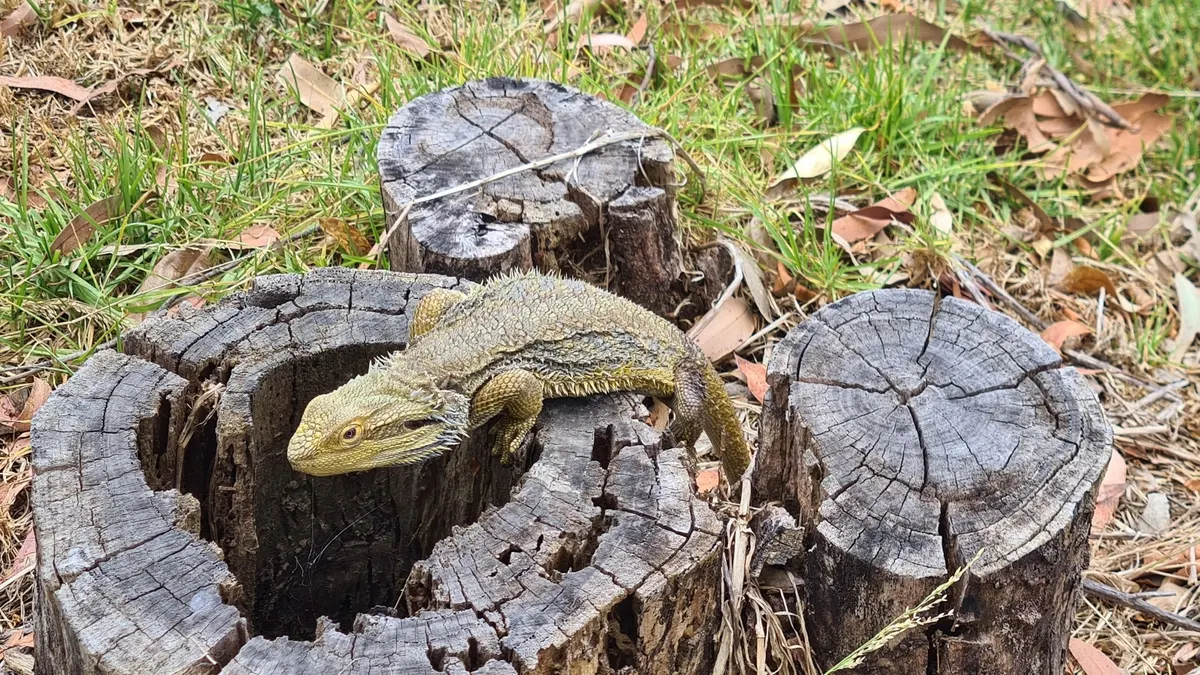
Cover photo: bartagame, bearded dragon, dragón barbudo del este, eastern bearded dragon, jew lizard by Petra Holland, CC BY 4.0, via inaturalist. Cropped.
Related guides
Best Glass Terrariums for Reptiles in 2026, Matched to Species
Six glass terrariums compared on doors, ventilation, base and weight, with the species each size fits.
Best PVC Reptile Enclosures of 2026: 4x2x2, Tall and 3-Foot Picks
Six PVC enclosures compared on the makers' specs, with the species each one fits by veterinary and welfare size guidance.
Best Reptile Hides of 2026: Dry, Humid and Natural Caves
Most reptiles need a hide at each end of the enclosure, and many need a humid one too. These are the caves that fit, by size and material.