
Reptile UVB and Ferguson Zones Explained: How Much UVB Your Reptile Needs
Affiliate disclosure: product links on this page go to Amazon, or to the maker's own store for brands that sell only direct. As an Amazon Associate we earn from qualifying purchases, at no extra cost to you; a link to a maker's store earns us nothing. No retailer or brand sees our picks before they are published or has any say in them. How we choose.
The short answer: give your reptile a UV gradient that tops out, at the spot closest to the lamp, at the UV Index (UVI) its Ferguson zone calls for, and falls to zero in the shade. For a bearded dragon (zone 3 to 4) that means a basking spot of roughly UVI 3 to 6. For a leopard gecko or crested gecko (zone 1) it means a gentle maximum of about UVI 0.6 to 1.4. The zones come from field measurements of wild lizards and snakes by Ferguson and colleagues (Zoo Biology, 2010), and the way to apply them in an enclosure comes from the UV-Tool published by Baines and colleagues (Journal of Zoo and Aquarium Research, 2016). For the zone, basking temperature and day and night temperatures of 59 species, see our reptile temperature and UVB chart.
This guide explains what the zones are, which zone the common pet species fall into, how to turn a zone into a lamp and a distance using the makers' own output charts, and what mesh, glass and lamp age do to the numbers. Ask a reptile veterinarian about your own animal's health and lighting.
What the Ferguson zones are
Ferguson et al. measured the UV exposure that 15 species of lizards and snakes chose for themselves in the wild, in the southern United States and Jamaica, and sorted them into four groups by behaviour. The median UVI ran from 0.35 for zone 1 to 3.1 for zone 4. Baines et al. summarised the four zones in their Table 1, reproduced here.
| Zone | Behaviour | Zone range (average UVI) | Maximum UVI recorded |
|---|---|---|---|
| 1 | Crepuscular or shade dweller, thermal conformer | 0 to 0.7 | 0.6 to 1.4 |
| 2 | Partial sun or occasional basker, thermoregulator | 0.7 to 1.0 | 1.1 to 3.0 |
| 3 | Open or partial sun basker, thermoregulator | 1.0 to 2.6 | 2.9 to 7.4 |
| 4 | Mid-day sun basker, thermoregulator | 2.6 to 3.5 | 4.5 to 9.5 |
The "zone range" is the average of all readings taken where the animals were found. The "maximum" is the highest UVI any animal of that group was seen in. Baines et al. suggest giving the captive animal a gradient from zero, in full shade, up to the maximum for its zone at the closest point it can reach to the lamp.
Which zone is my reptile in?
The UV-Tool appendix assigns 254 species to zones from their known basking behaviour. These are the common pets this site covers.
| Species | Ferguson zone | Method that fits |
|---|---|---|
| Leopard gecko (Eublepharis macularius) | 1 | Shade method |
| Crested gecko (listed as Rhacodactylus ciliatus) | 1 | Shade method |
| Corn snake (Pantherophis guttatus) | 1 to 2 | Shade method |
| Ball python (listed as royal python, Python regius) | 2 | Shade method |
| Eastern blue-tongued skink (Tiliqua scincoides) | 2 to 3 | Shade or sunbeam method |
| Inland bearded dragon (Pogona vitticeps) | 3 to 4 | Sunbeam method |
Albino and hypomelanistic animals are the exception to the table. Baines et al. note that melanin absorbs UV, so animals lacking it are likely to need much lower exposure than their species' zone suggests. Ask a reptile veterinarian before lighting one.
The shade method and the sunbeam method
Shade method (zones 1 and 2). A low level of UV across a broad area, highest near the lamp and fading to zero. Baines et al. describe T8 fluorescent tubes as suited to this in small enclosures where the maximum needed is no more than UVI 0.7 to 1.0, and high-output T5 tubes for larger enclosures, mounted further away to reach the same low UVI at animal level. Most snakes, amphibians and crepuscular lizards fall here.
Sunbeam method (zones 3 and 4, and some zone 2 baskers). A higher UVI restricted to the basking spot, like a patch of sunlight, with a gradient to zero in the shade. The target is the UV of an early to mid-morning basking session: in open tropical and subtropical sun between 8:30 and 9:30 am the UVI is typically 3.0 to 5.0, per the authors' measurements. Even zone 4 species seen basking at UVI 9.5 or above spend most of their basking time at about UVI 3.0 to 5.0, so the authors place the best range for them there, and treat UVI 7.0 to 8.0 at reptile level as the absolute maximum under artificial UV.
Two more rules from the paper apply to both methods. The UV patch has to be at least as wide as the animal's whole body, and the heat and UV should overlap so the animal is not forced to choose between warmth and UV. That is why makers such as Arcadia advise grouping heat and light over one basking zone.
Turning a zone into a lamp and a distance
The UVI an animal receives depends on the lamp, its reflector, the distance and anything in between. The only reliable way to set it is with the maker's published output chart and, ideally, a UV Index meter (the studies and makers quoted here use the Solarmeter 6.5). Two examples from makers' charts:
| Distance | Forest 6% | Desert 12% | Dragon 14% |
|---|---|---|---|
| 12 in (300 mm) | 4.50 | 8.50 | 10.50 |
| 15 in (380 mm) | 3.60 | 6.50 | 7.00 |
| 20 in (500 mm) | 2.50 | 3.80 | 4.60 |
| 24 in (600 mm) | 1.20 | 2.40 | 3.20 |
| Zone (Zoo Med's UVI band) | Distance from bulb |
|---|---|
| Above UVI 7: no animal access | Under 10 in |
| Zone 4 (2.6 to 3.5+) | 10 to 19 in |
| Zone 3 (1.0 to 2.6) | 19 to 31 in |
| Zone 2 (0.7 to 1.0) | 31 to 36 in |
| Zone 1 (0.4 to 0.7) | 36 to 38 in |
Read these as starting points. For a bearded dragon, Arcadia sets its Dragon 14% lamp at about 15 in (35 to 40 cm) from the animal's back for an upper basking index of UVI 6. For a leopard gecko, Arcadia's ShadeDwellerPro 7% kit gives UVI 0.80 at 10 in and 0.65 at 12 in, which sits inside the zone 1 maximum. Baines et al. stress that charts are no substitute for measuring in your own enclosure, because reflectors, guards, branches and plants all change the result. The best UVB lights for reptiles page applies these charts to specific kits.
Mesh, glass and plastic
| Material | Effect on UVB | Source |
|---|---|---|
| Stainless steel mesh | Can reduce UVI by 30% or more | Arcadia (ShadeDwellerPro page) |
| Terrarium screen cover | Can filter out up to 50% of UVB | Zoo Med (T8 ReptiSun 10.0 page) |
| Ordinary 4 mm window glass | 0.4% transmission at 300 nm | Baines et al. 2016 |
| 4 mm high-transmission low-iron glass | 16.9% transmission at 300 nm | Baines et al. 2016 |
| 3 mm UV-transmitting acrylic | 80.9% transmission at 300 nm | Baines et al. 2016 |
The practical rule: never put ordinary glass or plastic between the lamp and the animal, and if the lamp sits on top of a mesh lid, expect a lower reading than the chart and move the lamp closer or choose a stronger lamp. Baines et al. recommend wide mesh where a guard is needed. Inside a PVC or wooden enclosure the lamp can be mounted under the ceiling with no mesh in the way, which is one reason the T5 vs T8 comparison matters more for mesh-top glass tanks.
UVB lamps lose output with age
UV output falls with use, mainly because the glass of the lamp solarises under UV bombardment. In the UV-Tool tests, seven Arcadia and Zoo Med fluorescent tubes lost an average of 12.6% of their UVI (range 6 to 23%) in the first 105 hours, and 39.9% on average (range 30 to 48%) after 4,000 hours, about a year at 10 to 12 hours a day. A lamp from another maker lost 64% after only 1,000 hours. Arcadia rates its T5 lamps for 12 months, and Zoo Med runs a 12-month UVB replacement reminder. A UV Index meter is the only way to know where a particular lamp stands.
Do nocturnal species need UVB?
The UV-Tool authors argue there is no reason to withhold it, provided the animal has a retreat and access to zone 1 levels. They cite work showing leopard geckos exposed to low-level UVB had 25-hydroxyvitamin D3 levels 3.2 times those of geckos given dietary supplements alone (Wangen et al. 2013), and corn snakes making vitamin D3 under low-level fluorescent UVB (Acierno et al. 2008). The species setups for leopard geckos, ball pythons and bearded dragons put these zones into a full enclosure plan.
Checklist
- Find your species' zone in the table above or in the UV-Tool appendix.
- Pick the shade method (zones 1 and 2) or the sunbeam method (zones 3 and 4).
- Choose a lamp whose maker publishes UVI at distance, and set the closest point the animal can reach to the zone maximum or below.
- Keep the hottest and highest-UV spot in the same place, wide enough for the whole animal, with shade to retreat to.
- Allow for mesh: expect 30 to 50% less UV through a screen top, per Arcadia and Zoo Med.
- Never let the animal reach a spot above UVI 7 to 8, the UV-Tool's absolute ceiling for zone 4.
- Replace fluorescent UVB lamps on the maker's schedule (12 months for Arcadia T5), or sooner if a meter shows the reading has dropped.
Frequently asked questions
What UV index does a bearded dragon need?
Bearded dragons are zone 3 to 4 in the UV-Tool, so the basking spot should reach the zone 4 range with a gradient to zero in the shade. Baines et al. put the best basking range for zone 4 at about UVI 3.0 to 5.0 and the absolute maximum at UVI 7.0 to 8.0. Arcadia sets its Dragon 14% T5 at about 15 inches for an upper basking index of UVI 6.
Do leopard geckos need UVB?
The UV-Tool assigns leopard geckos to zone 1 and recommends low-level UVB with a retreat, citing a study in which UVB-exposed leopard geckos had vitamin D3 metabolite levels 3.2 times those of geckos on supplements alone. Zone 1 means a maximum around UVI 0.6 to 1.4 at the closest point. Ask a reptile veterinarian about your own animal.
What is a Ferguson zone?
It is one of four groups of reptiles defined by how much UV they chose to be exposed to in the wild, from a 2010 field study of 15 lizard and snake species in the southern US and Jamaica. Zone 1 animals are shade dwellers with median exposure around UVI 0.35, and zone 4 animals are mid-day baskers with median exposure around UVI 3.1.
Does a screen lid block UVB?
Partly. Zoo Med says screen covers can filter out up to 50% of UVB, and Arcadia says stainless steel mesh can reduce the UV index by 30% or more. Ordinary glass and most plastics block almost all of it: Baines et al. measured 0.4% transmission at 300 nm through 4 mm window glass.
How often should I replace a UVB bulb?
Follow the maker: Arcadia rates its T5 lamps for 12 months and Zoo Med runs a 12-month replacement reminder. In the UV-Tool tests, good fluorescent tubes lost about 40% of their UV index after 4,000 hours, roughly a year of use, while one other brand lost 64% in 1,000 hours. A UV Index meter shows where your lamp actually is.
How far should a UVB light be from my reptile?
It depends on the lamp and the species' zone, so use the maker's chart. As examples, Arcadia's 14% T5 gives UVI 7.0 at 15 inches and 4.6 at 20 inches, and Zoo Med's 24-inch ReptiSun 10.0 hood reaches zone 4 levels from 10 to 19 inches. Measure if you can, because mesh, reflectors and decor change the reading.
Sources
- Voluntary exposure of some western-hemisphere snake and lizard species to ultraviolet-B radiation in the field: how much ultraviolet-B should a lizard or snake receive in captivity?, Zoo Biology 29(3):317-334 (Ferguson et al., 2010)
- How much UVB does my reptile need? The UV-Tool, a guide to the selection of UV lighting for reptiles and amphibians in captivity, Journal of Zoo and Aquarium Research 4(1):42-63 (Baines et al., 2016)
- ProT5 HO T5 UV-B Lighting Kit, Arcadia Reptile
- D3+ Dragon 14% UV-B lamp, Arcadia Reptile
- ShadeDwellerPro 7% UV-B kit, Arcadia Reptile
- ReptiSun T5 HO Terrarium Hood with 10.0 Bulb (UVI distance charts), Zoo Med Laboratories
- T8 ReptiSun 10.0 UVB, Zoo Med Laboratories
- UVB Reminder, Zoo Med Laboratories
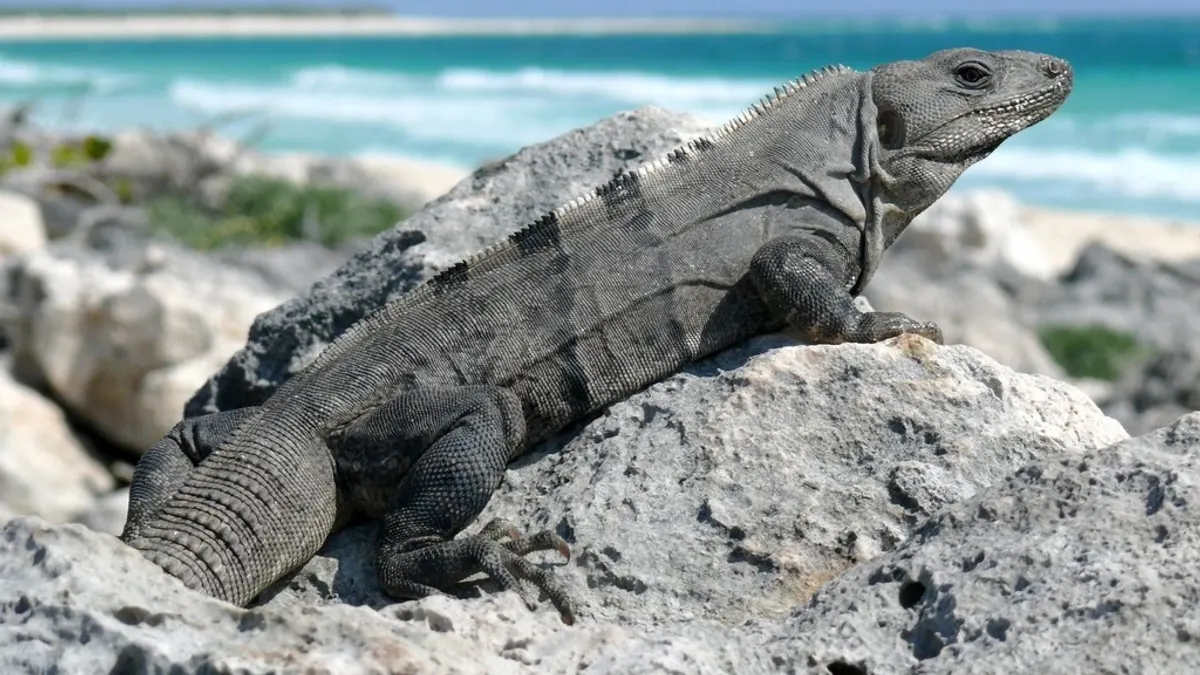
Cover photo: young Black Spiny-tailed Iguana (Ctenosaura, CC0 1.0, via rawpixel. Cropped.
Related guides
Reptile Temperature and UVB Chart: Basking, Day and Night Temps for 59 Species
A searchable chart of 59 lizards, snakes, tortoises and turtles: basking surface, daytime and night temperatures, UVB zone and, where Merck covers them, humidity and diet.
Best Reptile Heat Lamps of 2026: Halogen, Deep Heat and Ceramic
Basking lamps for daytime heat and light-free heaters for night, chosen on the makers' specs and fixture requirements.
Best Reptile Heat Mats of 2026: Under Tank Heaters Compared
Under tank heaters compared on size, wattage and the makers' mounting rules, plus why each needs a thermostat.