
Bioactive Cleanup Crew Guide: Springtails and Isopods Explained
Affiliate disclosure: product links on this page go to Amazon, or to the maker's own store for brands that sell only direct. As an Amazon Associate we earn from qualifying purchases, at no extra cost to you; a link to a maker's store earns us nothing. No retailer or brand sees our picks before they are published or has any say in them. How we choose.
The short answer: a bioactive cleanup crew is two groups of small animals, springtails and isopods, living in the substrate. Springtails are tiny (about 1/16 inch) hexapods that feed on decaying plant material, fungi, molds and algae; isopods (pillbugs and sowbugs) are land crustaceans that mainly eat decaying plant material. Together they break down leaf litter, mold and leftovers so the substrate does not sour. They do not replace you: the substrate makers still tell you to spot clean where the animal defecates. Start with one culture of each, keep at least part of the substrate damp, and keep a layer of leaf litter on top as their food.
The biology below comes from university extension services (UC Statewide IPM and Penn State Extension), and the setup advice from the substrate makers' own instructions. Ask a reptile veterinarian if your reptile seems unwell.
Springtails and isopods compared
| Springtails | Isopods (pillbugs and sowbugs) | |
|---|---|---|
| What they are | Wingless hexapods, order Collembola | Land crustaceans, order Isopoda |
| Size | About 1/16 inch (UC IPM); species range from 0.2 to 10 mm (Penn State) | Adults about 1/3 to 3/4 inch; newly emerged young about 1/12 inch |
| Food | Decaying plant material, fungi, molds, algae; also mildew and bacteria (Penn State) | Mainly decaying plant material |
| Moisture | Need high humidity and die without moisture | Live under damp litter and debris; drier soil reduces them |
| Breeding | Not covered in these sources | Eggs carried in a brood sac, hatch about a month later; young stay in the sac about 2 weeks |
| Life span | Not covered in these sources | Adults live 2 to 5 years |
| Harm to people or pets | "Will not bite or otherwise harm people or pets" (UC IPM) | Described as a nuisance indoors, not as harmful (UC IPM) |
What springtails do
Springtails are the mold control. UC IPM describes them as very small, wingless, jumping creatures that feed on decaying plant material, fungi, molds or algae, and that use a forked structure folded under the abdomen, the furcula, to spring into the air when disturbed (UC IPM). Penn State Extension adds mildew and bacteria to the menu and says springtails "require high humidity environments" such as leaf litter and mulch (Penn State Extension).
That diet is why springtails earn their place: mold on wood, leaves or damp soil is springtail food. Their need for moisture is also the limit. UC IPM says they soon die indoors unless they find moisture, so in a dry desert enclosure they survive only where the substrate stays damp.
What isopods do
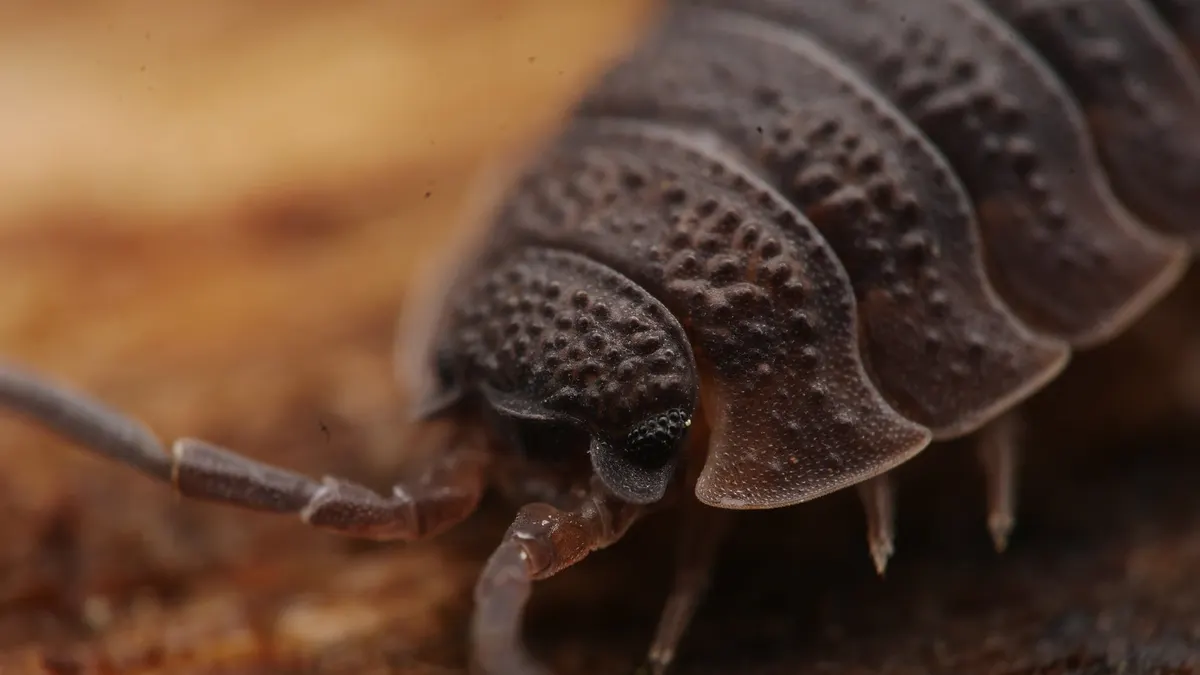
Isopods are the bigger shredders. UC IPM calls pillbugs and sowbugs soil-dwelling crustaceans in the order Isopoda that mainly eat decaying plant material and help break down organic matter (UC IPM). Adults are about 1/3 to 3/4 inch long and live two to five years. Females carry their eggs in a brood sac; the eggs hatch about a month after they are produced, and the young stay in the sac for about two weeks, then molt every one to two weeks for several months as they grow.
The two common kinds are easy to tell apart: pillbugs curl into a ball like a pill when disturbed, while sowbugs cannot roll up and run away instead, and have distinct appendages sticking out at the rear (UC IPM). UC IPM's advice for getting rid of them in gardens, keeping the soil surface drier, tells you what they need in an enclosure: damp substrate under a layer of litter.
What a cleanup crew does not do
- It does not remove the need to spot clean. The Bio Dude says its substrates still need spot cleaning in the areas the animal uses (The Bio Dude), and the RSPCA says to spot clean waste as soon as it appears (RSPCA).
- It does not make the substrate permanent. Josh's Frogs says to stir the surface of its BioBedding every 1 to 2 weeks and replace it after several years (Josh's Frogs).
- It does not live on air. Leaf litter is its food and cover. The Bio Dude says leaves and other biodegradables break down in about 2 to 3 months in tropical setups and 3 to 4 months in arid ones, so top them up.
Dry versus humid enclosures
Both groups need moisture, so a tropical enclosure is easy and a desert one needs a plan. In a humid build with a substrate such as Josh's Frogs Tropical BioBedding, the whole floor suits them. In a desert build, The Bio Dude says its Terra Sahara is designed to hold water while allowing evaporation (The Bio Dude), and suggests keeping the substrate damp in the areas the animal uses as a toilet so the cleanup crew works faster there. That damp patch, under leaf litter and away from the basking spot, is where the crew will live.
| Setup | Where the crew lives | What to do |
|---|---|---|
| Tropical (crested gecko, tropical snakes) | Throughout the substrate and litter | Keep the substrate moist to the maker's squeeze test; top up leaf litter |
| Desert (bearded dragon, leopard gecko) | Damp lower layers and damp patches under litter | Keep waste areas damp, as The Bio Dude suggests; leaves break down more slowly (3 to 4 months) |
| Snakes and burrowers (ball python) | Throughout a damp, deep substrate | Moisten to saturated but not dripping, per The Bio Dude's Terra Firma guide |
How to add a cleanup crew
- Finish the substrate and leaf litter first; see our guide to setting up a bioactive enclosure.
- Add one culture of springtails and one of isopods directly to the enclosure, as The Bio Dude instructs (The Bio Dude).
- Run the enclosure before the animal goes in; the RSPCA advises a week for a new crested gecko enclosure.
- Keep at least part of the substrate damp and the leaf litter topped up.
- If you stop seeing either group, check the moisture first, since both need damp conditions (UC IPM; Penn State), then add a fresh culture.
Live springtails and isopods are sold by invertebrate breeders and are not sold through the links on this site. Leaf litter is:
If you collect leaves yourself, the Merck Veterinary Manual recommends oven baking natural leaf litter, soil and sand before use to sterilize them (Merck).
Next steps
The crew needs a home that holds damp substrate: see the best bioactive substrates and the best bioactive enclosures, and size the layers with our substrate calculator.
Frequently asked questions
What is a cleanup crew in a bioactive enclosure?
It is a population of springtails and isopods living in the substrate. Springtails feed on decaying plant material, fungi, molds and algae, and isopods mainly on decaying plant material, so together they break down leaf litter, mold and leftovers. You still spot clean.
Do springtails harm reptiles?
UC Statewide IPM says springtails will not bite or otherwise harm people or pets. They are about 1/16 inch long and feed on decaying plant material, fungi, molds and algae.
Do isopods eat reptile poop?
The extension sources we read describe isopods as eating mainly decaying plant material and helping break down organic matter; none says they remove droppings. The substrate makers still tell you to spot clean where the animal defecates.
Can you have a cleanup crew in a desert bioactive enclosure?
Yes, but both groups need moisture: UC IPM says springtails die without it and that drier soil reduces isopods. The Bio Dude suggests keeping the substrate damp in the areas the animal uses as a toilet so the crew works there, under a layer of leaf litter.
How many springtails and isopods do I need to start?
The Bio Dude's instruction is one culture of springtails and one culture of isopods added straight to the enclosure. They breed in place; isopod eggs hatch about a month after they are produced, according to UC IPM.
What is the difference between pillbugs and sowbugs?
Both are isopods. UC IPM says pillbugs curl into a ball when disturbed, while sowbugs cannot roll up, usually run away, and have distinct appendages sticking out at the rear.
What do I feed a cleanup crew?
Leaf litter is their main food and cover. The Bio Dude starts a new enclosure with about half an inch of leaves and says they break down in about 2 to 3 months in tropical setups and 3 to 4 months in arid ones, so top it up as it disappears.
Sources
- Pillbugs and Sowbugs, UC Statewide IPM Program
- Springtails (Pest Notes, Publication 74136), UC Statewide IPM Program
- Springtails, Penn State Extension
- How do I create a Terra Sahara BioActive Vivarium?, The Bio Dude
- How do I create a Terra Firma BioActive Setup?, The Bio Dude
- Josh's Frogs TROPICAL BioBedding Bioactive Substrate (10 quarts), Josh's Frogs
- Management and Husbandry of Reptiles, Merck Veterinary Manual
- Caring for your Crested Gecko, RSPCA
Cover photo: Porcellio scaber by Alexis, CC BY 4.0, via inaturalist. Cropped.
Related guides
Best Bioactive Reptile Enclosures of 2026: Deep Bases, Liners and Sizes
Five enclosures that hold a deep, damp soil bed, compared on base depth, waterproofing and size.
Best Bioactive Substrate for Reptiles in 2026: Desert, Tropical and Snake Mixes
Desert, tropical and burrower mixes plus drainage and leaf litter, with the makers' own depth and humidity rules.
How to Set Up a Bioactive Enclosure: Layers, Depths and the First Week
Each layer, how deep to lay it, when you can skip drainage, and the upkeep a bioactive enclosure still needs.