
How to Set Up a Bioactive Enclosure: Layers, Depths and the First Week
Affiliate disclosure: product links on this page go to Amazon, or to the maker's own store for brands that sell only direct. As an Amazon Associate we earn from qualifying purchases, at no extra cost to you; a link to a maker's store earns us nothing. No retailer or brand sees our picks before they are published or has any say in them. How we choose.
The short version: line or seal the base so it holds water, add a 2-inch drainage layer and a mesh barrier only if the substrate maker calls for one (tropical setups with automatic misting), lay at least 2.5 to 3 inches of a bioactive substrate moistened to the maker's instructions, add rock, wood and plants, cover with about half an inch of leaf litter, seed it with springtails and isopods, then run it for a week before the animal goes in. After that you still spot clean, stir the surface and top up leaf litter; bioactive is not maintenance free.
The layer depths and moisture levels below come from the substrate makers' own setup instructions (The Bio Dude and Josh's Frogs), and the safety and husbandry points from the Merck Veterinary Manual, the RSPCA and the New South Wales code. Ask a reptile veterinarian about your own animal's needs.
The layers at a glance
| Layer | Depth | When you need it | Source |
|---|---|---|---|
| Liner or sealed base | Not applicable | Any enclosure whose maker says it is not watertight | Zen Habitats FAQ; maker listings |
| Drainage layer (clay balls) | 2 in | Tropical substrate with automatic misting; very humid builds | Josh's Frogs; The Bio Dude |
| Mesh barrier | Not applicable | Always over a drainage layer | Josh's Frogs; The Bio Dude |
| Bioactive substrate | At least 3 in (The Bio Dude); 2.5 to 3 in (Josh's Frogs) | Always | The Bio Dude; Josh's Frogs |
| Leaf litter | About 1/2 in | Always | The Bio Dude |
| Springtails and isopods | One culture of each to start | Always | The Bio Dude |
1. Start with an enclosure that holds water
Damp soil sits against the base for years, so the base has to be watertight. Glass terrariums from Exo Terra and REPTI ZOO usually come with watertight bottoms. Zen Habitats says its PVC enclosures are not water tight and sells a fitted Bio-Basin liner (Zen FAQ), and other frame-and-panel enclosures tell you in their listings to seal the bottom with silicone. Check that the substrate barrier is taller than the layers you plan. Our best bioactive enclosures guide lists each enclosure's depth.
2. Decide whether you need a drainage layer
Many setups do not. The Bio Dude says its Terra Sahara (arid) needs no drainage layer and its Terra Firma needs none "90% of the time," with a porous drainage layer, never loose rock, only in very high humidity enclosures (The Bio Dude). Josh's Frogs says its Tropical BioBedding needs no drainage layer with light or hand misting, but with automatic misting it calls for a 2-inch false bottom and a substrate barrier (Josh's Frogs).
If you need one, use a clay drainage medium such as expanded clay balls or The Bio Dude's HydroGrow V2, which the maker says to rinse before use and which "MUST be used with a screen divider" (The Bio Dude). Keep it under the barrier: the Merck Veterinary Manual warns that gravel and pebbles are hard to clean and can cause gastrointestinal obstruction if a terrestrial reptile eats them (Merck).
3. Lay the barrier
The barrier is a sheet of fine mesh cut to the floor and laid on top of the drainage layer, so the soil stays above the water line and does not wash down into the clay. Josh's Frogs and The Bio Dude both call for one whenever there is a drainage layer.
4. Moisten and add the substrate
Each maker gives its own moisture test, and getting it right matters more than the brand:
- Terra Sahara (desert): soak in a bucket, then squeeze until it is about 50% saturated but not dripping; lay at least 3 inches (The Bio Dude). The maker says it holds a tunnel when moisture is kept at 25 to 40%.
- Terra Firma (snakes and burrowers): soak and squeeze until saturated but not dripping; at least 3 inches (The Bio Dude).
- Tropical BioBedding: mix the bag, add dechlorinated or RO water until it sticks together when squeezed with no water running out; 2.5 to 3 inches (Josh's Frogs).
Work out how many bags you need with our bioactive substrate calculator, and see the best bioactive substrates for which mix suits your animal's humidity. If you collect soil, sand or leaf litter yourself, the Merck Veterinary Manual recommends oven baking it first to sterilize it.
5. Add rock, wood and the basking spot
Place rock and wood before the leaf litter goes on. For lizards that bask in the open, such as bearded dragons, the New South Wales code asks for a log, rock or platform under the overhead heat source (NSW code), and every heat source runs through a thermostat, screened from the animal and placed at one end to make a gradient (Merck). Add several hides; the RSPCA asks for several for royal pythons.
6. Plant it
The Merck Veterinary Manual says nontoxic plants can help with humidity for the smallest species, but larger animals often damage them, so choose plants that suit both the animal's size and its humidity. The RSPCA describes an ideal crested gecko enclosure as having tall, broad plants that create light and shade (RSPCA).
7. Cover with leaf litter
The Bio Dude seeds a new enclosure with "a generous 1/2 inch layer" of leaves. Leaf litter is food and cover for the cleanup crew and breaks down over time, about 2 to 3 months in tropical setups and 3 to 4 months in arid ones by The Bio Dude's estimate, so plan to add more.
8. Add the cleanup crew
The Bio Dude's instruction is simple: add a culture of springtails and a culture of isopods directly to the enclosure. Springtails feed on molds, fungi and decaying plant material, and isopods mainly on decaying plant material; our cleanup crew guide covers which to choose for a dry or humid setup. Live cultures are sold by invertebrate breeders, not through the links on this page.
9. Run it for a week before the animal goes in
The RSPCA advises setting up the enclosure and running it for a week before introducing a crested gecko. Use that week to check the temperature at both ends and under the basking spot, the humidity, and the timer on the lights, and to let the cleanup crew settle.
Maintenance: what you still do
- Spot clean. The Bio Dude says the substrate needs spot cleaning in the areas the animal uses as a toilet, and the RSPCA says to spot clean waste as soon as it appears.
- Keep waste areas damp. The Bio Dude suggests keeping the substrate damp where the animal defecates so the cleanup crew works there faster.
- Stir and top up. Josh's Frogs says to stir the surface of BioBedding every 1 to 2 weeks; add leaf litter and sphagnum moss as they break down.
- Replace eventually. Josh's Frogs says to replace BioBedding after several years, once it breaks down.
- Clean the glass and decor. The Merck Veterinary Manual says soap and water are generally enough and that phenolic disinfectants are toxic. The RSPCA's crested gecko guidance also recommends a monthly full clean with a reptile-safe disinfectant; ask your reptile veterinarian how to apply that in a planted enclosure.
Checklist
- Enclosure watertight, or lined or sealed.
- Drainage layer and barrier only if the substrate maker calls for them.
- Substrate moistened to the maker's squeeze test and laid to at least the maker's minimum depth.
- Basking platform under the heat source; every heater on a thermostat.
- Plants suited to the animal's size and humidity.
- About 1/2 inch of leaf litter.
- Springtails and isopods added.
- Run for a week; check temperatures and humidity before the animal goes in.
Frequently asked questions
What layers go in a bioactive enclosure?
From the bottom: a watertight base or liner, a drainage layer and mesh barrier if your substrate maker calls for them, the bioactive substrate, and about half an inch of leaf litter on top, with springtails and isopods living in it. The Bio Dude's desert and burrower mixes need no drainage layer.
Do you need a drainage layer for bioactive?
Only for some setups. Josh's Frogs calls for a 2-inch false bottom and a barrier under its Tropical BioBedding when you use automatic misting, while The Bio Dude says Terra Sahara needs none and Terra Firma needs none in most enclosures. Any drainage layer needs a mesh barrier over it.
How long before I can put my reptile in a new bioactive enclosure?
The RSPCA advises running a new enclosure for a week before introducing a crested gecko. Use the time to check temperatures, humidity and lighting, and to let the springtails and isopods settle.
How wet should bioactive substrate be?
Follow the maker's squeeze test. The Bio Dude says to squeeze Terra Sahara to about 50% saturation without dripping and Terra Firma until saturated but not dripping, and Josh's Frogs says BioBedding should stick together when squeezed with no water running out.
Do you still clean a bioactive enclosure?
Yes. The Bio Dude says to spot clean where the animal defecates, Josh's Frogs says to stir the surface every 1 to 2 weeks, and leaf litter needs topping up every few months as it breaks down. Glass and decor still need cleaning.
Can I use soil and leaves from my yard?
The Merck Veterinary Manual says soil, sand and natural leaf litter can be used but recommends oven baking them first to sterilize them. Packaged bioactive substrates and cleaned leaf litter avoid that step.
Sources
- How do I create a Terra Sahara BioActive Vivarium?, The Bio Dude
- How do I create a Terra Firma BioActive Setup?, The Bio Dude
- The Science of Terra Firma, The Bio Dude
- HydroGrow V2 Drainage Layer 18 Quarts, The Bio Dude
- Josh's Frogs TROPICAL BioBedding Bioactive Substrate (10 quarts), Josh's Frogs
- FAQs, Zen Habitats
- Management and Husbandry of Reptiles, Merck Veterinary Manual
- Caring for your Crested Gecko, RSPCA
- Code of Practice for the Private Keeping of Reptiles, NSW Office of Environment and Heritage (2013)
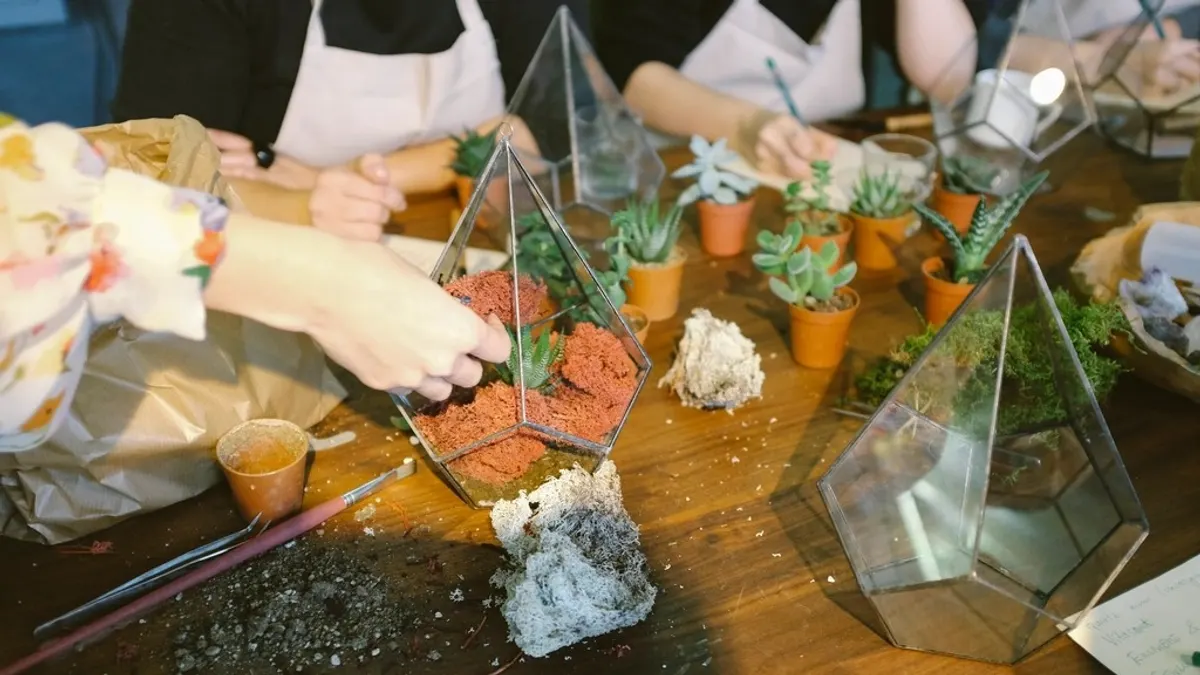
Cover photo: People attending terrarium workshop, CC0 1.0, via rawpixel. Cropped.
Related guides
Best Bioactive Reptile Enclosures of 2026: Deep Bases, Liners and Sizes
Five enclosures that hold a deep, damp soil bed, compared on base depth, waterproofing and size.
Best Bioactive Substrate for Reptiles in 2026: Desert, Tropical and Snake Mixes
Desert, tropical and burrower mixes plus drainage and leaf litter, with the makers' own depth and humidity rules.
Bioactive Cleanup Crew Guide: Springtails and Isopods Explained
Springtails and isopods: what each eats, what they need, and what they will not do for you.