
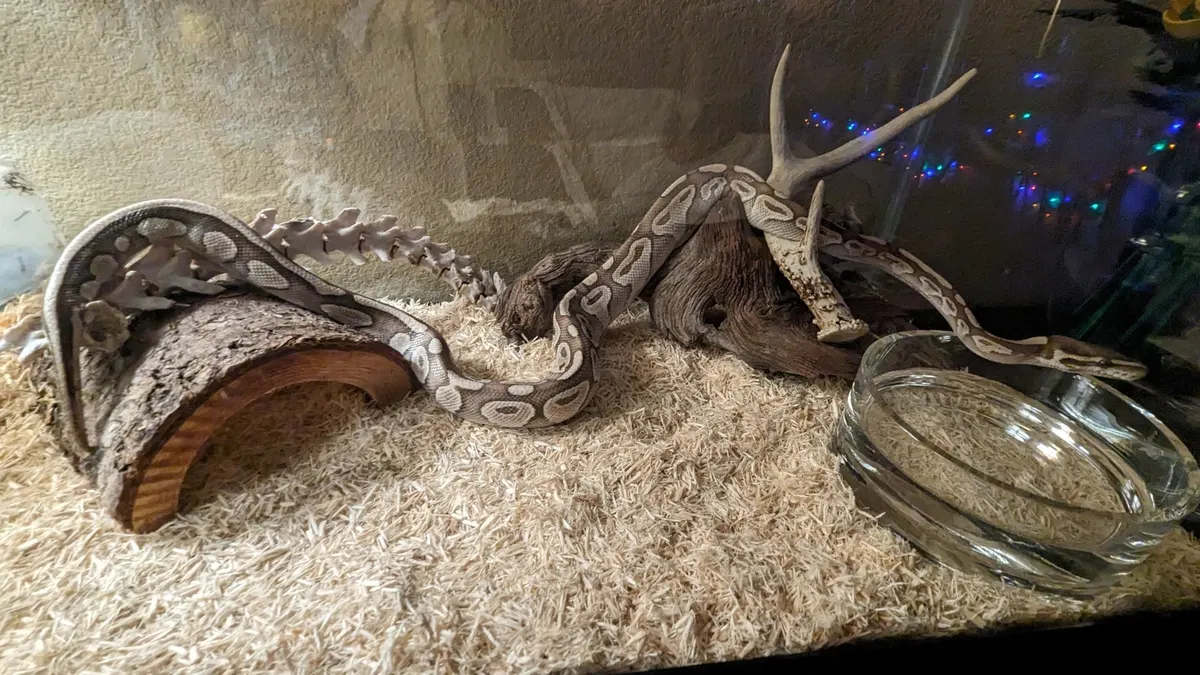
Ball Python Enclosure Setup: Size, Heat, Humidity and Hides
Affiliate disclosure: product links on this page go to Amazon, or to the maker's own store for brands that sell only direct. As an Amazon Associate we earn from qualifying purchases, at no extra cost to you; a link to a maker's store earns us nothing. No retailer or brand sees our picks before they are published or has any say in them. How we choose.
A ball python needs an enclosure about as long as the snake, with width and height of at least a third of its length (the RSPCA's rule), so a 4x2x2 foot enclosure suits most adults up to 4 feet and a 6x2x2 suits a 5 foot snake. Heat one end to 30 to 32°C (86 to 90°F) with the cool end at 24 to 26°C (75 to 79°F), keep humidity around 50 to 60% at the cool end, offer low-level UVB with full shade available, and put snug hides at both ends, one with damp moss. Every heater runs through a thermostat.
The setup at a glance
| What | Target | Source |
|---|---|---|
| Enclosure | Length at least the snake's length; width and height at least one third of it | RSPCA |
| Floor area | 0.6 square meters per meter of snake (boas and pythons) | Merck Veterinary Manual |
| Adult length | 3 to 5 feet (90 to 150 cm) | VCA |
| Warm (basking) zone | 30 to 32°C (86 to 90°F) | RSPCA |
| Warm end | 90 to 95°F (32 to 35°C) | VCA (snakes in general) |
| Basking surface | 35 to 40°C (95 to 104°F) | Baines et al. 2016 (UV-Tool) |
| Cool end | 24 to 26°C (75 to 79°F) | RSPCA |
| Air temperature range (POTZ) | 25 to 30°C (77 to 86°F) | Merck Veterinary Manual |
| Night | 24 to 26°C (75 to 79°F) air in summer | Baines et al. 2016 |
| UV index | 1.0 at the basking zone, zero in the shade (albinos 0.7 maximum) | RSPCA |
| Ferguson zone | 2 (partial sun, occasional basker) | Baines et al. 2016 |
| Humidity | About 50 to 60% at the cool end; about 80% when misted | RSPCA |
| Humidity | 50 to 80% | Merck Veterinary Manual |
Enclosure size
VCA says adult ball pythons usually reach 3 to 5 feet and need an enclosure large enough to stretch out. The RSPCA turns that into a rule: the enclosure should be at least as long as the snake, with width and height of at least a third of its length, so a 120 cm (4 foot) snake needs a minimum of 120 x 40 x 40 cm. A 150 cm (5 foot) snake would need 150 x 50 x 50 cm, or about 59 x 20 x 20 inches.
The Merck Veterinary Manual gives 0.6 square meters of floor per meter of snake for boas and pythons. For a 0.9 to 1.5 meter adult that is 0.54 to 0.9 square meters (5.8 to 9.7 square feet).
| Enclosure | Floor area | Meets RSPCA rule up to | Meets Merck figure up to |
|---|---|---|---|
| 3 x 1.5 x 1.5 ft (36 x 18 x 18 in) | 4.5 sq ft (0.42 m²) | 3 ft snake | About 70 cm (2.3 ft) snake |
| 4 x 2 x 2 ft | 8 sq ft (0.74 m²) | 4 ft snake | About 1.24 m (4.1 ft) snake |
| 6 x 2 x 2 ft | 12 sq ft (1.11 m²) | 6 ft snake | About 1.86 m (6.1 ft) snake |
VCA's snake housing sheet adds that every snake cage must be well ventilated and escape-proof, with sealed seams and a secure top that locks. For a humid species, PVC is easier: Zen Habitats, for example, rates its PVC panels for 0 to 100% humidity and its wood panels for 0 to 50%. Our PVC enclosure picks go further.
Heat and the temperature gradient
The RSPCA heats one end with a 60 to 100 watt reptile heat lamp, guarded and connected to a thermostat, adjusted until the basking zone reads 30 to 32°C with the cool end at 24 to 26°C. In smaller enclosures it uses a heat mat instead, which must run on an on/off thermostat and be protected by a mat guard. At night it provides heat that gives off no light.
Night figures vary. VCA's general snake sheet says heat is not necessary at night as long as the temperature stays at 65 to 70°F, while the UV-Tool paper by Baines and colleagues lists a summer night range of 24 to 26°C (75 to 79°F) for royal pythons. A ceramic heat emitter or deep heat projector on a thermostat keeps the warm end up without light; our heat lamp guide compares them and the thermostat guide says which controller type suits each.
VCA says to cover any bulb so the snake cannot touch it and to avoid hot rocks, which it calls dangerous and ineffective.
Humidity
Ball pythons need more humidity than bearded dragons or leopard geckos. The RSPCA says around 50 to 60% at the cool end, raised to around 80% with misting; the Merck manual gives 50 to 80%. VCA notes many snakes do well between 40 and 70%, depending on species. An organic soil that holds moisture helps, as does a hide with damp moss. If you mist on a schedule, see our misting system picks.
UVB lighting
VCA says veterinarians are divided about UV for snakes but that providing it "is certainly not harmful and may be beneficial". The RSPCA asks for a 2 to 7% UVB tube, one half to one third of the enclosure length, in the roof at the hot end, with a UV index of 1.0 at the basking zone falling to zero in the shade (0.7 maximum for albino and similar morphs). The UV-Tool paper places royal pythons in Ferguson zone 2, whose recommended UV index range is 0.7 to 1.0 with a maximum of 1.1 to 3.0 at the closest point. Hides give the snake a way out of the light at any time.
Substrate
The RSPCA recommends organic soils made for reptiles, which hold humidity without going moldy, and says not to use sand, which can irritate the skin. VCA's snake sheet asks for a substrate that is easy to clean and non-toxic, warns that cedar shavings are toxic to reptiles, and discourages sand, gravel, wood shavings, corncob, walnut shells and cat litter because they can cause impaction.
Hides
The RSPCA asks for several hides at both ends of the enclosure, one containing moist moss. VCA lists an upside-down box, a hollow log, curved bark, a clay pot or a commercial cave. A hide at each end lets the snake choose its temperature without giving up cover. Our hide guide lists snake caves by size.
Shopping list
| Item | What to look for | Example |
|---|---|---|
| Enclosure | 4x2x2 ft PVC for most adults, 6x2x2 for a 5 ft snake; locking doors | Zen Habitats 4x2x2 PVC or Zen Habitats 6x2x2 PVC |
| Heat | Ceramic heat emitter or deep heat projector, guarded | Arcadia Deep Heat Projector, 50W |
| Thermostat | Proportional or dimming for an overhead heater; on/off for a mat | Vivarium Electronics VE-200 (pulse proportional) |
| UVB | Low-output tube (2 to 7%), one half to one third the length | Zoo Med ReptiSun 5.0 T5 HO lamp, 22 in in a 24 in T5 HO fixture with reflector |
| Thermometer and hygrometer | Digital, one at each end | Govee H5075 |
| Hides | Two, one at each end, sized to the snake | Exo Terra Snake Cave |
| Humid hide | Room for damp moss | Zoo Med Repti Shelter 3-in-1 |
Setup checklist
- Assemble the enclosure and check every door and vent closes tight.
- Fit the guarded heater over one end and wire it through the thermostat, probe at the basking spot.
- Mount the UVB tube at the same end.
- Add a layer of moisture-holding organic soil, both hides and the humid hide.
- Run the enclosure for a few days and adjust until the warm end reads 30 to 32°C, the cool end 24 to 26°C, and humidity 50 to 60%.
Spot clean waste as it appears and do a full clean monthly, per the RSPCA; VCA's snake sheet says to remove feces and urates every 24 to 72 hours. Our cleaning guide covers safe disinfectants. VCA notes that ball pythons may not eat for weeks to months after moving to a new home; ask a reptile veterinarian if yours is losing weight, and plan on the yearly exam with a fecal check that VCA recommends.
Frequently asked questions
What size enclosure does a ball python need?
The RSPCA says the enclosure should be at least as long as the snake, with width and height of at least a third of its length, so a 120 cm (4 foot) snake needs 120 x 40 x 40 cm or more. VCA says adults reach 3 to 5 feet, so a 4x2x2 foot enclosure suits most adults and a 6x2x2 suits a 5 foot snake.
What temperature should a ball python enclosure be?
The RSPCA gives 30 to 32°C (86 to 90°F) at the basking zone and 24 to 26°C (75 to 79°F) at the cool end. The Merck Veterinary Manual's air temperature range is 25 to 30°C (77 to 86°F). Use a thermostat on every heater and check both ends with a digital thermometer.
What humidity does a ball python need?
The RSPCA says around 50 to 60% at the cool end, rising to around 80% when misted. The Merck Veterinary Manual gives 50 to 80%. A moisture-holding organic soil and a hide with damp moss help keep it there.
Does a ball python need UVB?
VCA says vets are divided but that UV is not harmful and may be beneficial. The RSPCA asks for a 2 to 7% UVB tube giving a UV index of 1.0 at the basking zone and zero in the shade, with 0.7 as the maximum for albino morphs. The 2016 UV-Tool paper places royal pythons in Ferguson zone 2.
Is a 40 gallon tank big enough for a ball python?
Only for a young or small snake. A 40 gallon breeder-style tank has a 36 x 18 inch floor, which meets the RSPCA's length rule for a snake up to 3 feet. VCA says adults usually reach 3 to 5 feet, so most adults need a 4x2x2 foot enclosure or larger.
What is the best substrate for a ball python?
The RSPCA recommends organic soils made for reptiles, which hold humidity without going moldy, and advises against sand because it can irritate the skin. VCA warns that cedar shavings are toxic to reptiles.
Sources
- How To Care For a Royal Python, RSPCA
- Snakes: Constrictor, VCA Animal Hospitals
- Snakes: Housing, VCA Animal Hospitals
- Owning a Pet Snake, VCA Animal Hospitals
- Management and Husbandry of Reptiles, Merck Veterinary Manual
- How much UV-B does my reptile need? The UV-Tool, a guide to the selection of UV lighting for reptiles and amphibians in captivity, Journal of Zoo and Aquarium Research
- 4'x2'x2' Reptile Enclosure - The Zen Habitat 3.0, Zen Habitats
Cover photo: ball python, königspython, royal python by Austin R. Kelly, CC BY 4.0, via inaturalist. Cropped.
Related guides
Bearded Dragon Enclosure Setup: Size, Heat, UVB and Substrate
A 4x2x2 minimum, a 100 to 108°F basking spot, a UV index of 3 to 5 under the lamp and a dry cool end: the setup, figure by figure, with sources.
Best Bearded Dragon Enclosures of 2026: 4x2x2 and Bigger
A 4x2x2 is the floor for one adult bearded dragon. These are the enclosures that meet it, and the ones that go past it.
Best Leopard Gecko Enclosures of 2026: 36x18x18 and Up
A 10 gallon tank is the old advice. These 36 inch and 4 foot enclosures meet the current welfare and veterinary size guidance for one adult.