
How to Clean and Disinfect a Reptile Enclosure (Safely)
Affiliate disclosure: product links on this page go to Amazon, or to the maker's own store for brands that sell only direct. As an Amazon Associate we earn from qualifying purchases, at no extra cost to you; a link to a maker's store earns us nothing. No retailer or brand sees our picks before they are published or has any say in them. How we choose.
Clean a reptile enclosure in two layers: remove waste as soon as it appears, and once a month take everything out, wash it with soap and water, disinfect it with a reptile-safe product at the label's dilution and contact time, rinse if the product or the Merck Veterinary Manual says to, and let it dry before the animal goes back. That is the routine the RSPCA and the Royal Veterinary College's exotics service give for leopard geckos, bearded dragons, crested geckos and corn snakes. Do the dirty work away from the kitchen, and wash your hands after: the CDC says even healthy reptiles can carry Salmonella. Why it matters: CDC has linked 15 multistate Salmonella outbreaks to pet reptiles since 2011, listed in our reptile Salmonella outbreak tracker.
How often to clean
| Task | How often | Source |
|---|---|---|
| Remove waste | As soon as it appears | RSPCA, RVC |
| Remove feces and dried urates (snakes) | Every 24 to 72 hours | VCA |
| Clean and disinfect water dishes (snakes) | Every 24 to 72 hours | VCA |
| Change drinking water | Daily | VCA, RVC |
| Wash out the cage (snakes) | Weekly | VCA |
| Replace paper bedding; wash reptile carpet (bearded dragons) | At least weekly | VCA |
| Full clean with a reptile-safe disinfectant | Monthly | RSPCA, RVC |
| Replace loose substrate | Regularly, as it becomes soiled | Merck Veterinary Manual |
The sources differ in emphasis rather than substance: VCA's snake sheet washes out the cage weekly, while the RSPCA and RVC do a full disinfecting clean monthly with spot cleaning in between. VCA adds that reptile carpet needs washing more often when several lizards share an enclosure.
Cleaning versus disinfecting
Cleaning removes dirt and waste; disinfecting kills germs on a surface that is already clean. The Merck Veterinary Manual says soap and water are generally all that is required to clean cages, and that bleach can be used as long as rinsing is thorough. Do them in that order: Unusual Pet Vets, an Australian exotic-animal clinic, says all debris must be cleaned out before the disinfectant goes on.
Disinfectants compared
These are the products the veterinary sources name, plus two sold for reptile and animal housing, each with the dilution, contact time and rinse instructions from its maker or from the cited source.
| Product | Active ingredient | How to use | Contact time | Rinse? |
|---|---|---|---|---|
| Household bleach (5 to 9% sodium hypochlorite) | Sodium hypochlorite | 5 tablespoons (1/3 cup) per gallon, or 4 teaspoons per quart, of room temperature water, if the bottle gives no directions (CDC) | At least 1 minute, kept visibly wet (CDC), unless the label says longer | Yes, thoroughly (Merck Veterinary Manual) |
| F10SC Veterinary Disinfectant | Quaternary ammonium (5.4%) and polyhexamethylene biguanide (0.4%) concentrate | 1:250 (0.5 oz per gallon), per F10; 1 ml per 250 ml water (Unusual Pet Vets) | At least 15 minutes (Unusual Pet Vets); F10's page does not state one | "No rinsing required" (F10) |
| REScue Ready to Use | Not stated on the maker's product page | Spray from 6 to 8 inches | 1 minute, surface visibly wet (REScue) | Wipe dry or air dry; rinsing not mentioned (REScue) |
| Zoo Med Wipe Out 1 | Quaternary ammonium, 0.13% | Ready to use; saturate the surface | 5 minutes (Zoo Med) | Wipe all surfaces dry; animals back only when dry and ventilated (Zoo Med) |
Zoo Med says Wipe Out 1 kills a broad spectrum of bacteria including Salmonella choleraesuis and Pseudomonas aeruginosa, and REScue lists Salmonella enterica among the organisms killed at its 1 minute contact time. Read the label of the exact product you buy; the CDC says manufacturer instructions take priority over its own bleach recipe.
What not to use
- Phenolic disinfectants. The Merck Veterinary Manual says some cleansers, such as phenolic disinfectants, are toxic and should be avoided. Check the label's active ingredients.
- Mixed chemicals. The CDC says never to mix household bleach, or any disinfectant, with other cleaners or disinfectants.
- Harsh products your vet has not approved. VCA's snake housing sheet says to clean with ordinary soap and water and to avoid harsher products unless your reptile veterinarian approves them.
The monthly deep clean, step by step
- Move the animal to a secure, escape-proof temporary container at a safe temperature.
- Unplug lamps, heaters and misters. Zoo Med warns not to apply Wipe Out 1 in or on electrical equipment because of shock risk, and the same caution applies to any spray.
- Remove substrate, hides, branches and bowls. Bag soiled substrate for the trash. The Merck manual says substrates must be replaced regularly as they become soiled.
- Scrape and wash. Remove all debris, then wash every surface with soap and water.
- Disinfect at the label's dilution, keeping the surface wet for the full contact time in the table above.
- Rinse where the product or source calls for it: always after bleach, per the Merck manual. The RSPCA's leopard gecko guide says to rinse off a reptile-safe disinfectant and dry thoroughly.
- Dry and air out. Zoo Med says not to return animals until the habitat is dry and ventilated.
- Clean the furnishings the same way. Zoo Med says its ceramic Repti Shelter can be washed and sterilized; cork and wood carry no such claim from their makers, so replace them when heavily soiled. Our hide guide notes which hides are easiest to clean.
- Rebuild and check temperatures with the thermostat and thermometers before the animal goes back.
Where to clean it: Salmonella hygiene
The CDC says the most common germ carried by reptiles and amphibians is Salmonella, that even healthy animals can carry it, and that food, tank water, equipment and habitats can be contaminated. Its advice for cleaning:
- Clean tanks, feeders, water containers and other equipment outside the home if possible, away from gardens and drinking water.
- If you cannot clean outside, use a laundry sink or bathtub, and thoroughly clean and disinfect it before anyone else uses it.
- Never use the kitchen sink or food preparation areas.
- Pour tank water and other wastewater down the toilet, not sinks or drains.
- Wash your hands with soap and running water after cleaning the tank.
The CDC also says a veterinarian cannot stop a reptile from shedding Salmonella, so hygiene is the control. Ask your doctor about extra precautions for anyone in the home at higher risk of infection.
Enclosure materials
Unusual Pet Vets says an enclosure should be made of materials that do not absorb moisture. Glass fits that description, and the PVC makers say their panels are not damaged by humidity. Wood-composite enclosures such as New Age Pet's ECOFLEX are sold as moisture resistant but not waterproof, so wipe rather than flood them. The PVC vs glass comparison covers the trade-offs.
Bioactive enclosures are different
A bioactive enclosure uses living soil, plants and a cleanup crew of invertebrates, so the monthly strip-and-disinfect routine above does not fit it as written. Spot cleaning still applies. See our bioactive setup guide and cleanup crew guide for how they are maintained.
Quick checklist
- Spot clean waste the day it appears.
- Change drinking water daily.
- Deep clean monthly: wash, disinfect for the full contact time, rinse where required, dry.
- Unplug electrics before spraying.
- Clean outside or in a tub, never in the kitchen; wash your hands.
- Never mix cleaning chemicals; skip phenolic products.
Species-specific routines are in our leopard gecko and bearded dragon setup guides. If your reptile shows signs of illness after a cleaning, remove it from the enclosure, ventilate, and call a reptile veterinarian.
Frequently asked questions
How often should you clean a reptile enclosure?
Remove waste as soon as it appears and do a full clean with a reptile-safe disinfectant once a month, as the RSPCA and the Royal Veterinary College advise. VCA's snake sheet removes feces and urates every 24 to 72 hours and washes the cage weekly.
What disinfectant is safe for reptile enclosures?
Veterinary sources name diluted household bleach with thorough rinsing (Merck Veterinary Manual) and F10SC at a 1:250 dilution (Unusual Pet Vets). Products sold for animal housing, such as REScue and Zoo Med Wipe Out 1, list their contact times on the label. Avoid phenolic disinfectants, which the Merck manual calls toxic.
Can I use bleach to clean a reptile tank?
Yes, according to the Merck Veterinary Manual, as long as you rinse thoroughly. The CDC's recipe is 5 tablespoons (1/3 cup) of 5 to 9% bleach per gallon of room temperature water, left wet on the surface for at least 1 minute, unless the bottle gives other directions.
Do I need to rinse after disinfecting a reptile enclosure?
It depends on the product. The Merck manual says to rinse thoroughly after bleach, and the RSPCA says to rinse off a reptile-safe disinfectant and dry. F10 says its F10SC needs no rinsing, and Zoo Med says to wipe Wipe Out 1 dry and wait until the habitat is dry and ventilated.
How long does a disinfectant need to sit?
As long as the label says. REScue gives 1 minute, Zoo Med Wipe Out 1 gives 5 minutes, and Unusual Pet Vets uses at least 15 minutes for F10SC at 1:250. The CDC's bleach recipe needs at least 1 minute with the surface kept visibly wet.
Where should I clean reptile supplies?
Outside the home if possible, per the CDC, or in a laundry sink or bathtub that you clean and disinfect afterward. Never use the kitchen sink or food preparation areas, and pour tank water down the toilet.
Sources
- Reptiles and Amphibians | Healthy Pets, Healthy People, CDC
- Cleaning and Disinfecting with Bleach, CDC
- Management and Husbandry of Reptiles, Merck Veterinary Manual
- How To Care For a Leopard Gecko, RSPCA
- Snakes: Housing, VCA Animal Hospitals
- Bearded Dragons - Housing, VCA Animal Hospitals
- Caring for Blue-Tongued Skinks, Unusual Pet Vets
- F10SC Veterinary Disinfectant, Health and Hygiene (Pty) Ltd
- Rescue Ready to Use, Rescue Disinfectants
- Wipe Out 1, Zoo Med
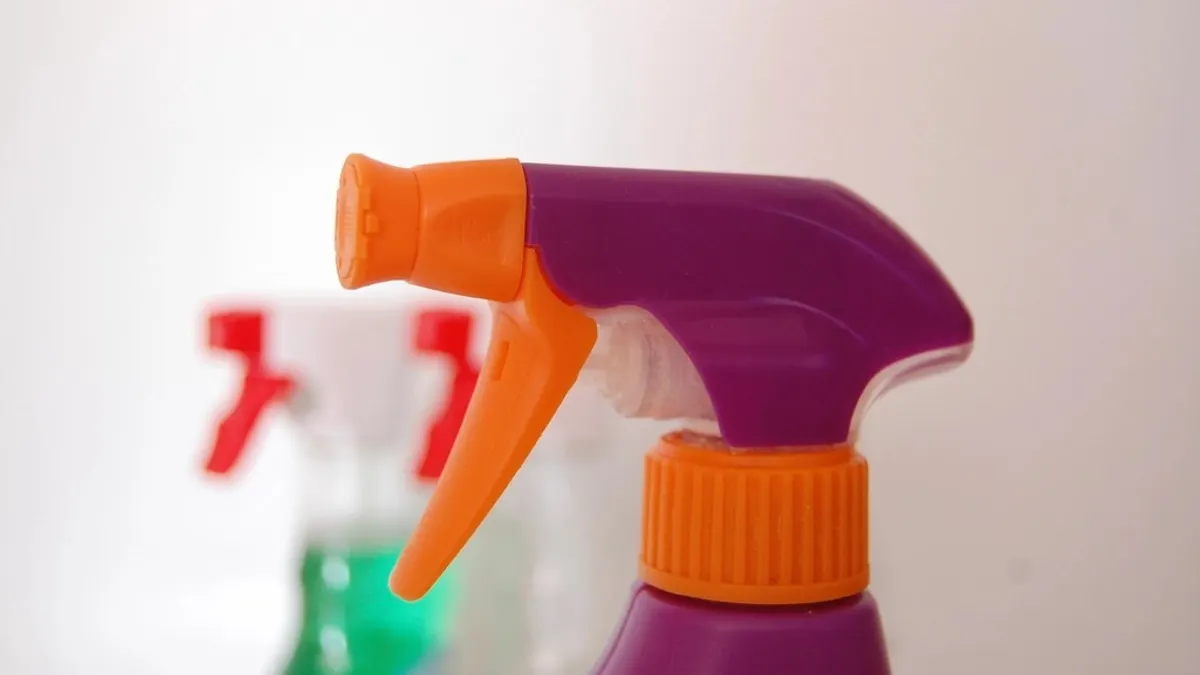
Cover photo: Spray bottles, CC0 1.0, via rawpixel. Cropped.
Related guides
Best Glass Terrariums for Reptiles in 2026, Matched to Species
Six glass terrariums compared on doors, ventilation, base and weight, with the species each size fits.
Best PVC Reptile Enclosures of 2026: 4x2x2, Tall and 3-Foot Picks
Six PVC enclosures compared on the makers' specs, with the species each one fits by veterinary and welfare size guidance.
Best Reptile Hides of 2026: Dry, Humid and Natural Caves
Most reptiles need a hide at each end of the enclosure, and many need a humid one too. These are the caves that fit, by size and material.