
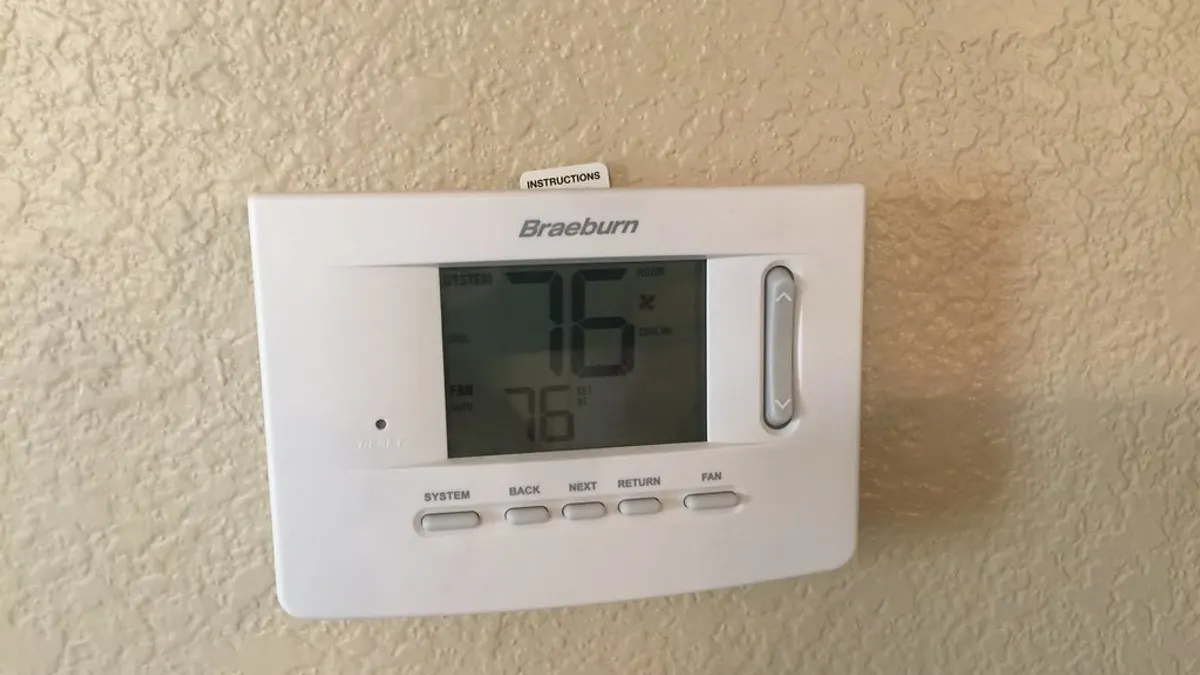
Best Reptile Thermostats of 2026: Dimming, Pulse and On/Off Picks
Affiliate disclosure: product links on this page go to Amazon, or to the maker's own store for brands that sell only direct. As an Amazon Associate we earn from qualifying purchases, at no extra cost to you; a link to a maker's store earns us nothing. No retailer or brand sees our picks before they are published or has any say in them. How we choose.
Our top pick is the Herpstat 1: a proportional thermostat with both dimming and pulse modes, a 700-watt rating, a sensor its maker rates at plus or minus 0.9°F, and a built-in safety relay that can cut power if its control circuit fails. It is sold direct by Spyder Robotics, not on Amazon. If you want to buy on Amazon, the Vivarium Electronics VE-200 is the proportional pick for mats, ceramic emitters and radiant panels, and the REPTI ZOO dimming thermostat is the budget choice for a single basking lamp.
Every heat source in a reptile enclosure, lamp or mat, should run through a thermostat; Arcadia's instructions, for one, say all its heat lamps should be used with one. The picks below are judged on what each thermostat's maker publishes: control type, load rating, set range, probes and safety features, and on which heaters the manuals say each type suits.
Our top picks at a glance
1. Best overall
Herpstat 1 thermostatControl type: Proportional: dimming or pulse · Max load: 700W total · Outputs: 1 outlet, 1 probe · Set range: 40 to 150°F
2. Best proportional thermostat on Amazon
Vivarium Electronics VE-200 thermostatControl type: Pulse proportional (per the Amazon listing) · Max load: 700W (per the Amazon listing) · Outputs: 1 outlet, 1 probe · Set range: Not stated on the maker's page
3. Best budget dimming thermostat for a heat lamp
REPTI ZOO Dimming Thermostat (TC02)Control type: Dimming (PID) · Max load: 300W (per the Amazon listing) · Outputs: 1 outlet, 1 probe · Set range: 41 to 140°F (per the Amazon listing)
4. Best on/off thermostat for heat mats and ceramic emitters
Zoo Med ReptiTemp Digital Thermostat (RT-600)Control type: On/off (heat or cool mode) · Max load: 600W heating, 150W cooling · Outputs: 1 outlet, 1 probe (6 ft) · Set range: 50 to 122°F
5. Best day/night thermostat on a budget
Inkbird ITC-306T day/night thermostatControl type: On/off, heating only · Max load: 1,200W at 120V (10A total) · Outputs: 2 outlets, 1 probe · Set range: Not stated on the listing
6. Best cheap controller for a heat mat
BN-LINK Digital Heat Mat Thermostat (40-108°F)Control type: Outlet switching; no dimming or pulse mode listed · Max load: 1,000W (8.3A) · Outputs: 1 outlet, 1 probe · Set range: 40 to 108°F
| Pick | Control type | Max load | Outputs | Set range | Buy |
|---|---|---|---|---|---|
| Herpstat 1 thermostatBest overall | Proportional: dimming or pulse | 700W total | 1 outlet, 1 probe | 40 to 150°F | Spyder Robotics |
| Vivarium Electronics VE-200 thermostatBest proportional thermostat on Amazon | Pulse proportional (per the Amazon listing) | 700W (per the Amazon listing) | 1 outlet, 1 probe | Not stated on the maker's page | Amazon |
| REPTI ZOO Dimming Thermostat (TC02)Best budget dimming thermostat for a heat lamp | Dimming (PID) | 300W (per the Amazon listing) | 1 outlet, 1 probe | 41 to 140°F (per the Amazon listing) | Amazon |
| Zoo Med ReptiTemp Digital Thermostat (RT-600)Best on/off thermostat for heat mats and ceramic emitters | On/off (heat or cool mode) | 600W heating, 150W cooling | 1 outlet, 1 probe (6 ft) | 50 to 122°F | Amazon |
| Inkbird ITC-306T day/night thermostatBest day/night thermostat on a budget | On/off, heating only | 1,200W at 120V (10A total) | 2 outlets, 1 probe | Not stated on the listing | Amazon |
| BN-LINK Digital Heat Mat Thermostat (40-108°F)Best cheap controller for a heat mat | Outlet switching; no dimming or pulse mode listed | 1,000W (8.3A) | 1 outlet, 1 probe | 40 to 108°F | Amazon |
Best overall
Herpstat 1 thermostat
The most capable single-zone thermostat here: dimming or pulse control, 700W, a safety relay and tenth-of-a-degree settings, for keepers who will buy direct.
- Control type
- Proportional: dimming or pulse
- Max load
- 700W total
- Outputs
- 1 outlet, 1 probe
- Set range
- 40 to 150°F
- Sensor accuracy
- ±0.9°F (maker figure)
- Warranty
- 1 year limited
Pros
- Switch between dimming (lamps) and pulse (mats, tape, emitters) in the menu
- Safety relay can disconnect the outlet if the solid-state control fails
- Shuts heat off if the probe fails or is disconnected
- Day/night ramping of up to 10 hours, high/low tracking and alarms
Cons
- Sold direct by Spyder Robotics only; not on Amazon
- One output: a second heater means a second unit or a Herpstat 2 (sold out when we checked)
- Costs several times a budget dimmer
The Herpstat 1 is a desktop controller with one outlet and one probe. Its maker lists a usable range of 40 to 150°F, display and settings in tenths of a degree, and a sensor accurate to plus or minus 0.9°F. The difference is its fail-safes: a built-in relay can disconnect the outlet if the solid-state control fails, a timeout can cut power if the low temperature is not reached within 30 minutes, and the heat shuts off if the sensor fails or is unplugged.
The manual explains the two heating modes. Dimming adjusts the voltage like a household dimmer and is "in most cases" the best performing mode; pulse sends varied lengths of power and helps avoid hum on metal rack systems. The same manual says it is not recommended for rock heaters or anything in direct contact with the animal. A SpyderWeb version with remote monitoring costs $10 more.
Who should skip it: anyone heating one small enclosure on a tight budget, or anyone who needs two zones from one box. The REPTI ZOO dimmer covers a single lamp for a fraction of the price, and the Inkbird ITC-306T gives two outlets for on/off heaters.
Best proportional thermostat on Amazon
Vivarium Electronics VE-200 thermostat
A US-made, 700-watt pulse proportional thermostat with a safety shutoff relay, best for heat mats, ceramic emitters and radiant panels.
- Control type
- Pulse proportional (per the Amazon listing)
- Max load
- 700W (per the Amazon listing)
- Outputs
- 1 outlet, 1 probe
- Set range
- Not stated on the maker's page
- Night drop
- With the optional Night Drop Module
Pros
- Built-in safety shutoff relay and Hi/Lo history, per Vivarium Electronics
- Stackable tabletop case for racks and multiple enclosures
- User-replaceable fuse and memory through power cuts (per the Amazon listing)
Cons
- The maker's site does not publish a temperature range or accuracy figure
- Night drop needs a separate module and timer
- Costs several times as much as the budget picks
Vivarium Electronics describes the VE-200 as a tabletop thermostat with a back-lit display of probe temperature and set point, Hi/Lo history tracking, Night Drop capability and a built-in safety shutoff relay, in a stackable case. The Amazon listing, sold by the reptile retailer Reptile Basics, adds the 700-watt rating and calls it pulse proportional. Pulse proportional control suits heat mats, heat tape and ceramic emitters, the heaters Herpstat's manual pairs with its own pulse mode.
Night drop is not built in: the maker sells a Night Drop Module, with a light timer, for the VE-100 and VE-200. The VE-300 has night drop built in, per the maker.
Who should skip it: owners of a single basking lamp, who are better served by a dimming thermostat. If you want the published accuracy figures and a choice of modes in one box, the Herpstat 1 costs a little more direct.
Best budget dimming thermostat for a heat lamp
REPTI ZOO Dimming Thermostat (TC02)
A low-cost PID dimming thermostat for one basking lamp up to 300 watts, the control type heat-lamp makers recommend.
- Control type
- Dimming (PID)
- Max load
- 300W (per the Amazon listing)
- Outputs
- 1 outlet, 1 probe
- Set range
- 41 to 140°F (per the Amazon listing)
Pros
- Dimming control, which Arcadia recommends for halogen and deep heat lamps
- Set range reaches desert basking temperatures
- Remembers settings after a power cut (per the listing)
Cons
- No day/night schedule is described on the listing
- Specs here come from the Amazon listing, not a published manual
- No safety relay of the Herpstat or VE-200 kind is listed
REPTI ZOO sells this as a PID dimming thermostat designed for heat lamps. The listing gives a 300-watt maximum output load, a control range of 41 to 140°F and memory after power loss, and tells owners not to use it with a sunlamp. It also advises placing the probe at least 15 cm (6 in) from the heat source rather than directly under it, and notes that if the set point is close to the actual temperature the output can drop very low.
Dimming is the control type the lamp makers ask for. Arcadia says its halogen lamps should run on a suitable dimming thermostat and that a dimming thermostat gives accurate control of a deep heat projector. For a single 50 to 100 watt basking lamp, this is the cheapest way to meet that.
Who should skip it: anyone who wants a night-time drop on the same unit, or a heater above 300 watts. The Inkbird ITC-306T has separate day and night settings for on/off heaters, and the Herpstat 1 does both in one box.
Best on/off thermostat for heat mats and ceramic emitters
Zoo Med ReptiTemp Digital Thermostat (RT-600)
A simple, well-documented 600-watt on/off thermostat with an alarm, from a reptile brand that publishes a full manual.
- Control type
- On/off (heat or cool mode)
- Max load
- 600W heating, 150W cooling
- Outputs
- 1 outlet, 1 probe (6 ft)
- Set range
- 50 to 122°F
- Warranty
- 1 year
Pros
- Programmable high/low alarm
- Memory keeps settings through power failures
- Can run a cooling fan in cool mode
Cons
- On/off only: no dimming for lamps
- 122°F ceiling and no day/night schedule
- Not for rock heaters, per Zoo Med
Zoo Med's ReptiTemp Digital Thermostat (RT-600) turns heating devices on below the set point and off at it. The manual lists heat lamps, under tank heaters and ceramic heat emitters as heaters it controls in heat mode, a range of 50 to 122°F, a 6-foot remote sensor, and a maximum of 600 watts of resistive heating. Its alarm can be set to sound when the temperature strays a chosen number of degrees from the set point, which is a useful early warning that a heater has failed.
The manual's safety notes are worth following whatever thermostat you buy: grounded 120V outlet only, no three-to-two-prong adapters, the control unit outside the enclosure and only the sensor inside, and not for rock heaters.
Who should skip it: owners running a basking lamp, who are better off with a dimmer, and anyone who wants a cooler night setting without adding a second controller.
Best day/night thermostat on a budget
Inkbird ITC-306T day/night thermostat
Two heating outlets, separate day and night temperatures and a high 1,200-watt rating for on/off heaters, at a budget price.
- Control type
- On/off, heating only
- Max load
- 1,200W at 120V (10A total)
- Outputs
- 2 outlets, 1 probe
- Set range
- Not stated on the listing
- Day/night
- Separate day and night temperatures
Pros
- Day and night set points on a 24-hour cycle
- Over/under-temperature alarm turns off all outputs, per the listing
- Temperature calibration and dual display
Cons
- On/off only, so a lamp on it switches fully on and off
- Both outlets follow the same probe and set point
- Sold as a general-purpose controller (seedlings, brewing), not a reptile product
Inkbird's listing describes the ITC-306T as a heating-only on/off controller with two outlets, a maximum combined load of 10 amps (1,200 watts at 120V), separate day and night temperature settings, temperature calibration and a fixed over/under-temperature alarm that turns off all outputs and sounds a buzzer. The day/night cycle lets a ceramic heat emitter or deep heat projector hold a lower set point overnight without a second device.
Both outlets share one probe, so they act as one zone. That suits a heat mat plus a ceramic emitter on the same enclosure, not two enclosures.
Who should skip it: anyone controlling a basking lamp, where a dimming thermostat is the better match, per Arcadia. For a single heat mat with no night drop, the BN-LINK costs less.
Best cheap controller for a heat mat
BN-LINK Digital Heat Mat Thermostat (40-108°F)
An ETL-listed, 1,000-watt outlet thermostat that does one job, holding a heat mat at its set point, for under $20.
- Control type
- Outlet switching; no dimming or pulse mode listed
- Max load
- 1,000W (8.3A)
- Outputs
- 1 outlet, 1 probe
- Set range
- 40 to 108°F
- Listing
- ETL listed (UL 60730-1 and 60730-2-9)
Pros
- ETL listed, per BN-LINK
- Simple three-button setup
- Hanging tab and heating indicator light
Cons
- 108°F ceiling is too low to control a desert basking lamp
- No alarm, no night setting, no timer
- Accuracy not published
BN-LINK lists this controller at 1,000 watts (8.3 amps) on 120V, with a 40 to 108°F control range, a display range of 32 to 140°F and an ETL listing to UL 60730-1 and 60730-2-9. The listing says it is for heating devices only, such as heating pads and heat lamps. In practice the 108°F ceiling decides its job: it is fine for holding the floor above a heat mat, but the UV-Tool lists basking surface temperatures of 40 to 45°C (104 to 113°F) for bearded dragons, which a 108°F limit cannot reach.
Who should skip it: anyone controlling a basking lamp or wanting an alarm. Spend more on the Zoo Med RT-600 for an alarm, or on a dimming thermostat for a lamp.
How we chose
We started from the heater makers' instructions, because they decide what kind of thermostat a heater needs, then read each thermostat maker's own page, manual or listing for five things: control type, maximum load, set range, probes and outputs, and safety features such as alarms, sensor-failure shutoff and relays. Where a figure appears only on the Amazon listing, we say so. Only the Herpstat's maker publishes a sensor accuracy figure, so we do not rank on accuracy.
Match the thermostat to the heater
| Heater | Use | Source |
|---|---|---|
| Halogen or incandescent basking lamp | Dimming | Arcadia (halogen lamps); Herpstat manual |
| Deep heat projector | Dimming | Arcadia |
| Ceramic heat emitter | Pulse proportional or on/off | Zoo Med (thermostat or rheostat; sold with its on/off 500R) |
| Heat mat, heat tape, heat cable | Pulse proportional or on/off | Herpstat manual; Zoo Med RT-600 manual |
| Heat rock | Not on these thermostats | Zoo Med RT-600 and Herpstat manuals exclude rock heaters |
| Fluorescent UVB lamp | No thermostat or dimmer | Zoo Med: its ReptiSun lamps need line voltage |
What to look for
Control type
On/off thermostats switch the heater fully on below the set point and off at it. Proportional thermostats vary the power: dimming lowers the voltage, pulse sends short bursts of full power. Spyder Robotics calls dimming the best performing mode in most cases and recommends pulse for non-lamp heaters on metal racks or where probe wiring picks up interference. The lamp makers ask for dimming: Arcadia says its halogen heaters should run on "a suitable dimming thermostat."
Load rating, with headroom
Add up the rated watts of everything on one controller and stay under the thermostat's maximum. The ratings here run from 300 watts (REPTI ZOO, per its listing) to 1,200 watts (Inkbird ITC-306T at 120V). A 100-watt lamp and a 50-watt deep heat projector total 150 watts, well inside any of them; a rack of mats or a room heater is a different matter.
Set range and probe
Make sure the range covers your hottest set point. A heat-mat controller topping out at 108°F (BN-LINK) cannot run a desert basking lamp, while dimmers reaching 140°F (REPTI ZOO, per its listing) or 150°F (Herpstat) can. The probe goes where the heat matters: Zoo Med's manual notes that wherever the sensor is placed is where the thermostat measures, and Spyder Robotics warns against covering the probe tip with aluminum tape.
Night drop, alarms and failure modes
A night setting lets one controller run a cooler night with a deep heat projector or ceramic emitter. An alarm warns you when the enclosure drifts out of range. The most valuable feature is what happens when something breaks: the Herpstat shuts heat off on a sensor failure and has a relay to cut power if its own control fails, and Vivarium Electronics lists a safety shutoff relay on the VE-200.
Comparison
| Thermostat | Type | Max load | Range | Night setting | Alarm |
|---|---|---|---|---|---|
| Herpstat 1 | Dimming or pulse | 700W | 40 to 150°F | Yes, with ramping | Yes |
| Vivarium Electronics VE-200 | Pulse proportional | 700W | Not published | With add-on module | Hi/Lo history |
| REPTI ZOO TC02 | Dimming | 300W | 41 to 140°F | Not listed | Not listed |
| Zoo Med RT-600 | On/off | 600W | 50 to 122°F | No | Yes |
| Inkbird ITC-306T | On/off | 1,200W | Not listed | Yes | Fixed range |
| BN-LINK heat mat thermostat | Outlet switching | 1,000W | 40 to 108°F | No | No |
Sources for each figure are in the pick details above; listing-only figures are marked there.
What to skip
- A rheostat in place of a thermostat. Zoo Med describes a rheostat as basically a dimmer that manually reduces power; it does not react when the room warms up.
- Any thermostat or dimmer on a fluorescent UVB lamp. Zoo Med says its ReptiSun and PowerSun UV lamps need specific line voltages and cannot be used with its thermostat.
- Heat rocks on a thermostat. Both Zoo Med's RT-600 manual and Spyder Robotics exclude them.
- Running a basking lamp on a heat-mat controller. The lamp makers ask for dimming thermostats, and a 108°F ceiling may not reach desert basking temperatures.
Before you plug anything in, read our reptile heating safety guide, and check the thermostat's work with one of the thermometers we recommend. For the heaters themselves, see the best reptile heat lamps and best reptile heat mats. A proportional thermostat also lowers a heater's average draw, which the electricity cost calculator lets you price.
Frequently asked questions
What kind of thermostat do I need for a reptile heat lamp?
A dimming thermostat. Arcadia says its halogen heat lamps should run on a suitable dimming thermostat and that dimming gives accurate control of a deep heat projector, and Spyder Robotics calls dimming the best performing mode in most cases. Check that the thermostat's load rating is above the lamp's wattage.
What is the best thermostat for a heat mat?
A pulse proportional or on/off thermostat with the probe on the floor above the mat. The Vivarium Electronics VE-200 is a pulse proportional choice rated at 700 watts per its listing, and the Zoo Med ReptiTemp RT-600 is an on/off choice with an alarm. On a budget, the BN-LINK 1,000-watt controller holds a mat at up to 108 degrees F.
Do I need a thermostat if I have a heat mat with a built-in temperature limit?
Yes, run it through one. A built-in limit is the mat's own maximum, not the temperature your animal needs, and BN-LINK sells its 8 x 12 inch mat as running at 104 to 122 degrees F. A thermostat with its probe at the warm spot holds the temperature you set and responds when the room or substrate changes.
Can one thermostat control two heaters?
Yes, if both are in the same zone and their combined wattage is under the thermostat's rating. The Inkbird ITC-306T has two heating outlets on one probe with a 1,200-watt limit at 120V. Two enclosures need two probes, so use two thermostats or a multi-output unit.
What is the difference between pulse proportional and dimming?
Both vary a heater's power instead of switching it fully on and off. Dimming lowers the voltage like a household dimmer, which suits lamps; pulse sends varied bursts of full power, which suits mats, tape and ceramic emitters. The Herpstat manual notes pulse mode can avoid the hum some metal racks make under dimming.
Where should the thermostat probe go?
At the spot whose temperature you want to control: the basking surface under a lamp, or the floor above a heat mat, fixed where the animal cannot move it. Zoo Med notes the thermostat measures wherever the sensor is placed, REPTI ZOO advises keeping its probe at least 15 cm from the heat source, and only the probe goes inside the enclosure.
Sources
- Herpstat 1 product page, Spyder Robotics
- Herpstat 1 and 2 User Manual, Spyder Robotics
- Thermostats (VE-100, VE-200, VE-300, Night Drop Module), Vivarium Electronics
- ReptiTemp Digital Thermostat (RT-600) and instructions, Zoo Med Laboratories
- ReptiTemp 500R Remote Sensor Thermostat (FAQ), Zoo Med Laboratories
- Digital Heat Mat Thermostat Controller 40-108°F, BN-LINK
- Halogen Infrared Heater, Arcadia Reptile
- Deep Heat Projector, Arcadia Reptile
- How much UVB does my reptile need? The UV-Tool (appendix of species parameters), Journal of Zoo and Aquarium Research (Baines et al., 2016)
Cover photo: Thermostat mounted on wall by districtmedia1, CC BY 2.0, via Flickr. Cropped.
Related guides
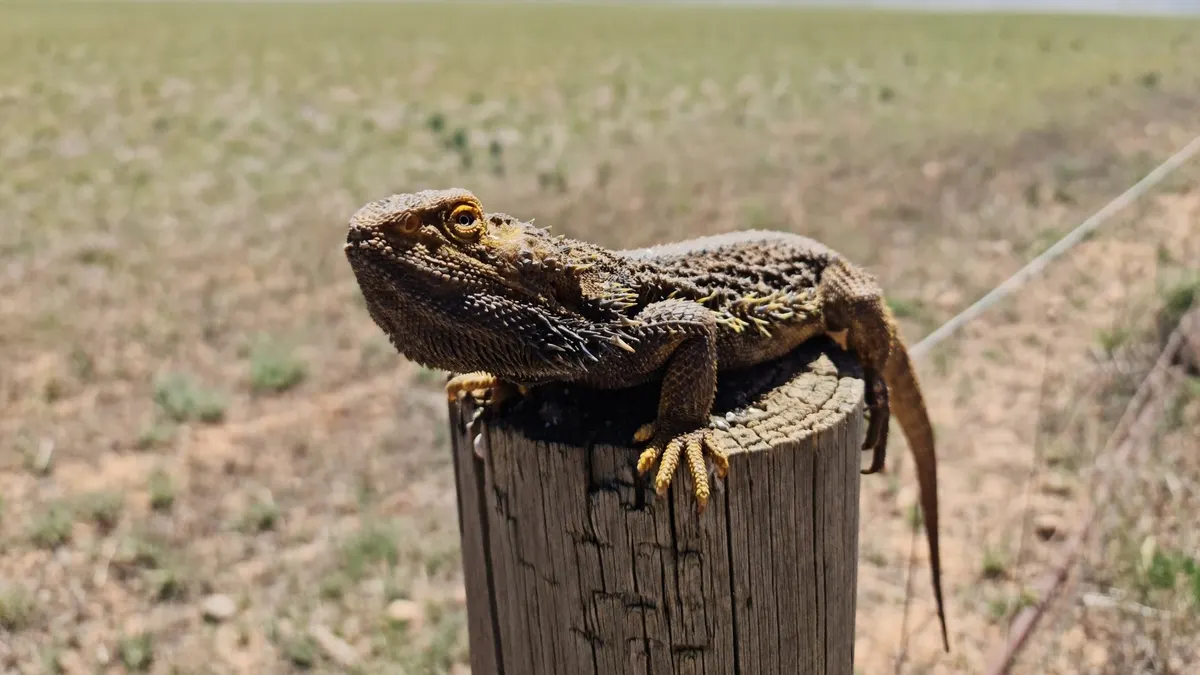
Reptile Temperature and UVB Chart: Basking, Day and Night Temps for 59 Species
A searchable chart of 59 lizards, snakes, tortoises and turtles: basking surface, daytime and night temperatures, UVB zone and, where Merck covers them, humidity and diet.
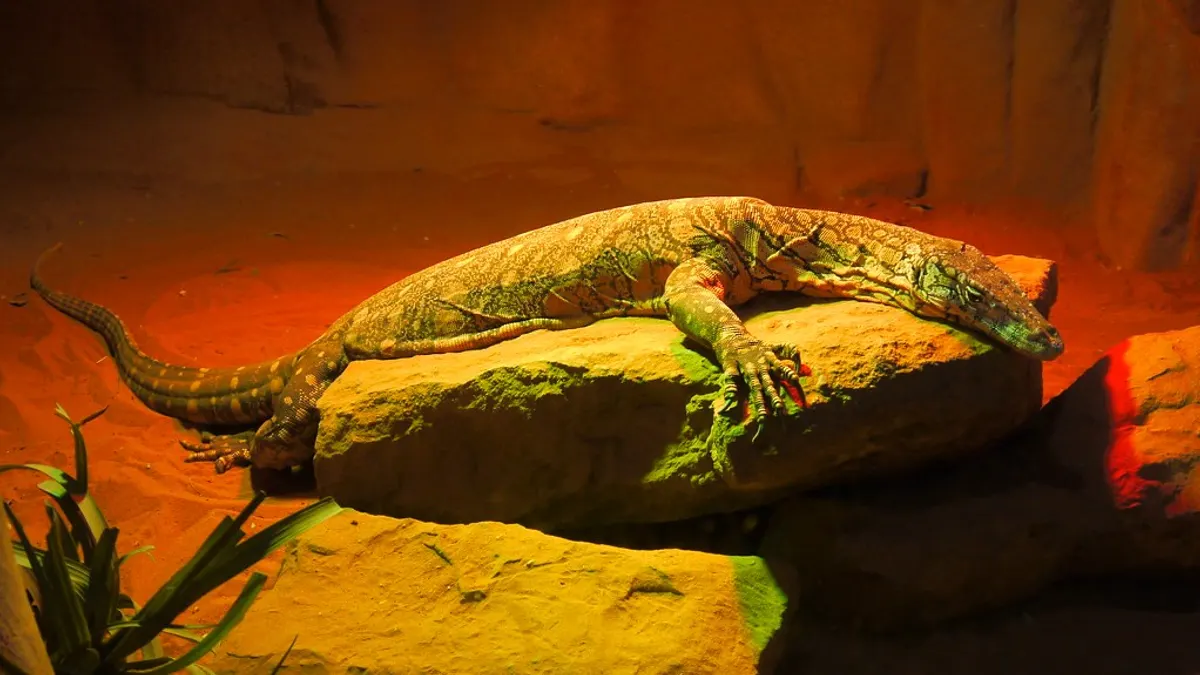
Best Reptile Heat Lamps of 2026: Halogen, Deep Heat and Ceramic
Basking lamps for daytime heat and light-free heaters for night, chosen on the makers' specs and fixture requirements.

Best Reptile Heat Mats of 2026: Under Tank Heaters Compared
Under tank heaters compared on size, wattage and the makers' mounting rules, plus why each needs a thermostat.