
Bearded Dragon Enclosure Setup: Size, Heat, UVB and Substrate
Affiliate disclosure: product links on this page go to Amazon, or to the maker's own store for brands that sell only direct. As an Amazon Associate we earn from qualifying purchases, at no extra cost to you; a link to a maker's store earns us nothing. No retailer or brand sees our picks before they are published or has any say in them. How we choose.
One adult bearded dragon needs an enclosure of at least 4 x 2 x 2 feet, a basking spot of 38 to 42°C (100 to 108°F), a cool end of 22 to 26°C (72 to 79°F), a UV index of 3.0 to 5.0 at the basking spot falling to zero in the shade, and humidity around 30 to 40%. Those are the RSPCA's figures. VCA Animal Hospitals and the Merck Veterinary Manual give slightly different numbers, set out below, and every heat source runs through a thermostat.
The setup at a glance
| What | Target | Source |
|---|---|---|
| Enclosure, one adult | 120 x 60 x 60 cm minimum (4 x 2 x 2 ft) | RSPCA |
| Enclosure, one adult | 60 to 100 gallons or larger; length at least 3x total body length | VCA |
| Basking spot | 38 to 42°C (100 to 108°F) | RSPCA |
| Warm end | 90 to 100°F (32 to 38°C) | VCA |
| Basking surface | 40 to 45°C (104 to 113°F) | Baines et al. 2016 (UV-Tool) |
| Cool end | 22 to 26°C (72 to 79°F) | RSPCA |
| Cool end | 75 to 80°F (24 to 27°C) | VCA |
| Air temperature range (POTZ) | 25 to 32°C (77 to 90°F) | Merck Veterinary Manual |
| Night | Not below 20 to 22°C (68 to 72°F) | RSPCA |
| UV index at basking spot | 3.0 to 5.0, zero in the shade (albinos 3.0 maximum) | RSPCA |
| Ferguson zone | 3 to 4 | Baines et al. 2016 |
| Humidity | About 30 to 40% at the cool end | RSPCA |
| Humidity | 20 to 30% | Merck Veterinary Manual |
| Light cycle | 12 hours on, 12 hours off | RSPCA |
Enclosure size
There is no US legal minimum, so the figures come from welfare and veterinary sources. The RSPCA's minimum for one adult is 120 cm long, 60 cm high and 60 cm wide, a 4x2x2 foot enclosure. VCA's veterinarians say a juvenile can start in a 20 gallon aquarium, adults need 60 to 100 gallons or more, and the length should be at least three times the dragon's total length. With adults reaching 18 to 22 inches nose to tail (VCA), that rule asks for 54 to 66 inches of length.
The Merck Veterinary Manual gives a floor-area formula for terrestrial lizards: 0.2 square meters per 10 cm of total length. For a 45 to 56 cm adult that is 0.9 to 1.12 square meters (9.7 to 12.1 square feet), against 8 square feet in a 4x2x2. So 4x2x2 is the floor; a 5 or 6 foot enclosure meets more of the guidance. Our best bearded dragon enclosures list sizes each pick against these three sources.
Plan on one adult per enclosure. VCA says only one adult male should be housed in an enclosure, because males fight, and adult females housed together may also become aggressive.
Heat and the temperature gradient
The dragon controls its own temperature by moving between a hot basking spot at one end and a cooler, shaded end. The RSPCA uses a 60 to 100 watt basking bulb at one end, fitted with a wire mesh guard, and says the dragon's back should not get closer than 25 to 30 cm (about 10 to 12 inches) to the lamp. VCA says heat sources belong outside the enclosure, above one end.
Run the basking lamp through a dimming thermostat with its probe at the basking spot. The Merck manual says heaters "of an appropriate size should be thermostat controlled, screened from the animals". The RSPCA's care guides pair a heat lamp with a dimming thermostat and a heat mat with an on/off type; see our thermostat guide for which type suits which heater. Put a digital thermometer at each end, as VCA recommends, and check the basking surface with an infrared thermometer, as the RSPCA suggests.
At night, turn the lights off. The RSPCA says the temperature should not drop below 20 to 22°C (68 to 72°F) and suggests a ceramic heater, which gives off no light, on a thermostat if your room runs colder. The Merck manual notes that light bulbs cannot be used to provide nocturnal heat. VCA gives a wider night window, with the cool end at 65 to 80°F (18 to 26°C), and says the temperature should drop when the light goes off.
Skip heat rocks. VCA calls hot rocks and sizzle rocks dangerous and ineffective, and the Merck manual says they frequently burn larger reptiles.
UVB lighting
VCA says bearded dragons need UV light to use vitamin D3, which helps the body absorb calcium from the diet. The 2016 UV-Tool paper by Baines and colleagues, written by a UV lighting specialist and keepers from several European zoos, places the inland bearded dragon in Ferguson zone 3 to 4, the open-sun and mid-day sun baskers. The RSPCA asks for a gradient from a UV index of 3.0 to 5.0 in the basking zone down to zero in the shade, with a maximum of 3.0 for albino morphs, checked with a UV index meter.
To get there, the RSPCA recommends a high-output 10 to 12% UVB tube with a reflector, running up to half the enclosure's length and placed toward the hot end. Mount it so nothing but air sits between tube and dragon where you can: VCA says there must be no glass or plastic between the pet and the light, and mesh also cuts output (the Baines paper advises wide mesh where a guard is needed). Run the UVB and basking lamp on a timer for a 12 hour day.
Replace the tube on the maker's schedule. VCA says every six months or as directed by the manufacturer, and the Merck manual says fluorescents every 9 to 12 months. In the Baines paper's test of seven fluorescent UVB tubes over 4,000 hours of use, UV index fell by 30 to 48% (39.9% on average), which is why a meter beats a calendar. Our Ferguson zones guide explains the numbers and our UVB lamp picks compare tubes.
Humidity
Keep it dry. The RSPCA says humidity at the cool end should normally be around 30 to 40% and suggests more ventilation if it runs high. The Merck manual's table gives 20 to 30%. Measure at the cool end with a digital hygrometer.
Substrate
This is where the sources disagree, so here are both positions:
- VCA prefers newspaper, butcher paper or recycled paper pellets, or reptile carpet washed weekly, and says not to use sand, gravel, wood shavings, corn cob, walnut shells, cat litter or calcium sand, because swallowed particles can cause impaction. Cedar shavings are toxic to reptiles.
- The RSPCA says reptile-safe sand or a sand and soil mix is acceptable for healthy adults (clean play sand, not builders' sand), and also lists natural slate or rough stone tiles over reptile carpet with a separate digging box. It agrees on avoiding calcium sand, bark, wood chips, walnut and corn cob.
Both agree that a loose substrate a dragon might swallow is a risk worth weighing. Paper and tile carry no swallowing risk at all; ask a reptile veterinarian before moving a juvenile or a dragon with a health problem onto sand or soil.
Hides, basking and furniture
The RSPCA asks for a hide at each end so the dragon can feel secure at any temperature, plus a digging box at the cool end. VCA suggests a clay pot, a cardboard box or a commercial cave, and large climbable rocks and low, secure branches as basking spots. The basking platform should be wide enough that the whole body sits in the heat and UV: the Baines paper recommends a basking zone at least as large as the animal's whole body. Our hide guide lists caves big enough for an adult dragon.
Shopping list
| Item | What to look for | Example |
|---|---|---|
| Enclosure | 48 x 24 x 24 in or larger, front opening | Phailozoo 120 Gallon 4x2x2 |
| Basking lamp | Halogen flood, sized to reach 38 to 42°C at the spot | Arcadia Optimal Heating Pack (75W halogen flood plus 50W deep heat projector) |
| Dimming thermostat | Dimming type, rated above the lamp's wattage | REPTI ZOO Dimming Thermostat (TC02) |
| UVB | High-output T5 tube, 10 to 14%, with reflector | Arcadia ProT5 UVB Kit, Dragon 14%, 39W |
| Thermometers | A digital thermometer-hygrometer at each end, plus an infrared thermometer for the basking surface | Govee H5075 and Etekcity Lasergrip 774 |
| Hides | Two, one at each end, big enough to cover the whole dragon | Zoo Med Natural Cork Bark Round, Extra Large (check the opening against your animal) |
| Timer | For a 12 hour light cycle | Any plug-in timer rated for the load |
Setup checklist
- Assemble the enclosure on a level stand rated for the full weight with substrate.
- Fit the basking lamp in a guarded fixture above one end and the UVB tube toward the same end.
- Wire the basking lamp through the dimming thermostat and both lamps through the timer.
- Set the basking platform so the dragon's back stays at least 25 to 30 cm from the lamp.
- Run the empty enclosure for a few days and adjust until the basking spot, cool end and night temperatures sit in range.
- Measure the UV index at the basking spot and in the shade.
- Add the substrate, hides at both ends and a dig box at the cool end, then the dragon.
Cleaning routines and safe disinfectants are covered in our enclosure cleaning guide. Diet and supplements are beyond this guide; ask a reptile veterinarian.
Frequently asked questions
What temperature should a bearded dragon's basking spot be?
The RSPCA gives 38 to 42°C (100 to 108°F) for the basking zone. VCA gives 90 to 100°F for the warm end, and the 2016 UV-Tool paper lists a basking surface of 40 to 45°C. Measure the basking surface with an infrared thermometer and control the lamp with a dimming thermostat.
What size tank does a bearded dragon need?
The RSPCA minimum for one adult is 120 x 60 x 60 cm, a 4x2x2 foot enclosure. VCA says adults need 60 to 100 gallons or more and a length at least three times the dragon's total length, which is 54 to 66 inches for an 18 to 22 inch adult.
What UV index does a bearded dragon need?
The RSPCA asks for a UV index of 3.0 to 5.0 at the basking spot, falling to zero in the shade, and a maximum of 3.0 for albino morphs. The 2016 UV-Tool paper places bearded dragons in Ferguson zone 3 to 4. Check with a UV index meter rather than assuming.
How often should I replace a bearded dragon's UVB bulb?
VCA says every six months or as directed by the manufacturer, and the Merck Veterinary Manual says fluorescent tubes every 9 to 12 months. A test of seven fluorescent tubes in the 2016 UV-Tool paper found output fell 30 to 48% over 4,000 hours of use, so a UV index meter tells you more than the date.
Do bearded dragons need heat at night?
Lights should go off at night. The RSPCA says the temperature should not drop below 20 to 22°C (68 to 72°F) and suggests a ceramic heater, which gives off no light, on a thermostat if the room gets colder. VCA says the cool end can sit at 65 to 80°F at night.
Is sand safe for bearded dragons?
The sources disagree. VCA advises against sand and calcium sand because swallowed particles can cause impaction, and prefers paper or reptile carpet. The RSPCA says reptile-safe sand or a sand and soil mix is acceptable for healthy adults. Ask a reptile veterinarian before using sand for a juvenile or a dragon with health problems.
What humidity does a bearded dragon need?
Low. The RSPCA says around 30 to 40% at the cool end, and the Merck Veterinary Manual gives 20 to 30%. If it runs higher, the RSPCA suggests more ventilation.
Sources
- How To Care For Your Bearded Dragon, RSPCA
- Bearded Dragons - Housing, VCA Animal Hospitals
- Bearded Dragons - Owning, VCA Animal Hospitals
- How To Care For a Leopard Gecko, RSPCA
- Management and Husbandry of Reptiles, Merck Veterinary Manual
- How much UV-B does my reptile need? The UV-Tool, a guide to the selection of UV lighting for reptiles and amphibians in captivity, Journal of Zoo and Aquarium Research
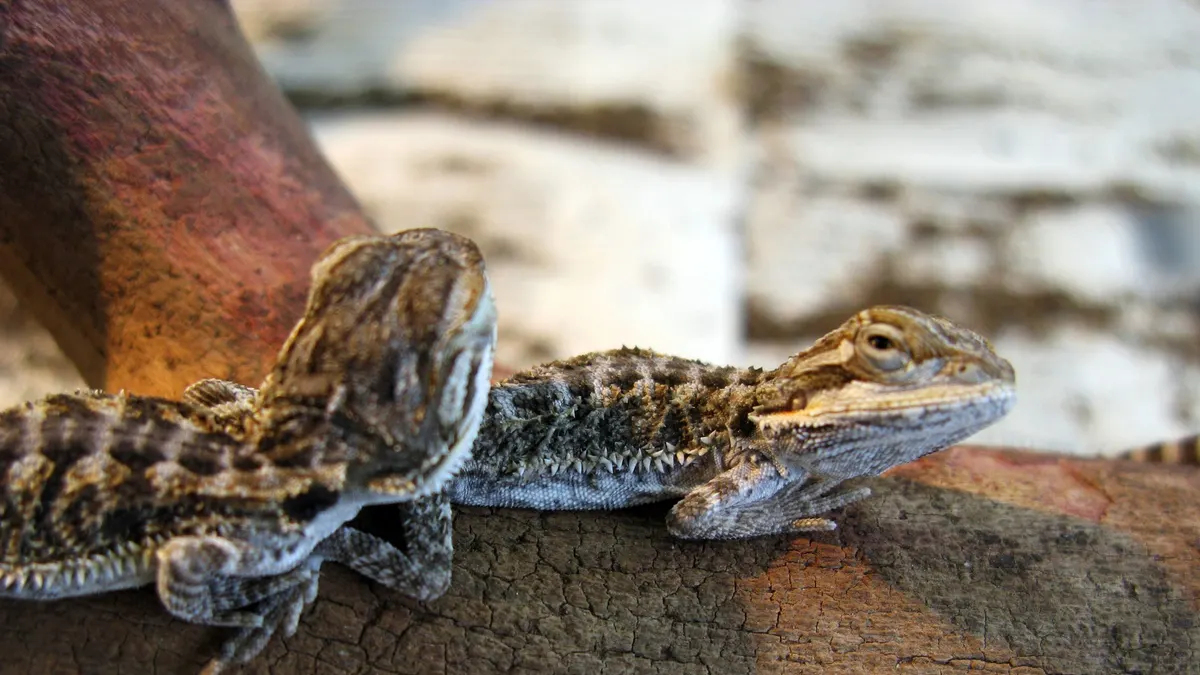
Cover photo: bartagame, central bearded dragon, dragón barbudo central, streifenköpfige bartagame by Igor Balashov, CC BY 4.0, via inaturalist. Cropped.
Related guides
Ball Python Enclosure Setup: Size, Heat, Humidity and Hides
Length to match the snake, a 30 to 32°C warm end, 50 to 60% humidity and tight, dark hides at both ends: the ball python setup with its sources.
Best Bearded Dragon Enclosures of 2026: 4x2x2 and Bigger
A 4x2x2 is the floor for one adult bearded dragon. These are the enclosures that meet it, and the ones that go past it.
Best Leopard Gecko Enclosures of 2026: 36x18x18 and Up
A 10 gallon tank is the old advice. These 36 inch and 4 foot enclosures meet the current welfare and veterinary size guidance for one adult.