
Reptile Heating Safety: Thermostats, Guards, Fixtures and Fire Prevention
Affiliate disclosure: product links on this page go to Amazon, or to the maker's own store for brands that sell only direct. As an Amazon Associate we earn from qualifying purchases, at no extra cost to you; a link to a maker's store earns us nothing. No retailer or brand sees our picks before they are published or has any say in them. How we choose.
The short answer: run every heat source through a thermostat rated above its wattage, with the probe where the animal basks; keep every bulb and heater out of the animal's reach behind a guard or outside the enclosure; use ceramic-socket fixtures rated for the bulb; plug into a wall outlet, not a chain of power strips; and have working smoke alarms. Each of those rules comes from the heater and thermostat makers' manuals or the U.S. Fire Administration (USFA), quoted below. Heat lamps, mats and their wiring can overheat, burn animals and start fires; a thermostat is the part that stops a heater running flat out when something goes wrong.
The USFA counts an estimated 24,200 residential building electrical fires reported to US fire departments in 2021, causing an estimated 295 deaths, 900 injuries and over $1.2 billion in property loss. A reptile setup adds heaters that run for hours every day, often unattended, so it is worth doing properly.
1. A thermostat on every heater
The makers say it plainly. Arcadia writes of its Deep Heat Projector, "As with all lamps, should be used with a thermostat," and recommends good dimming thermostats with probes for its halogen lamps. Its heat lamp cage page ends: "always use a suitable Thermostatic control system with heating system." Heat mats need one too: BN-LINK's 8 x 12 inch mat is sold as giving steady heat between 104 and 122°F, and Zoo Med says its ReptiTherm under tank heater operates at about 95 to 100°F. Without a controller, a mat's output does not change when the room warms up or a hide gets dragged over it.
Match the thermostat type to the heater
| Heater | Thermostat type | What the makers say |
|---|---|---|
| Halogen or incandescent basking lamp | Dimming | Arcadia: "should be used with a suitable dimming thermostat." Herpstat: dimming is "in most cases" the best performing mode. |
| Deep heat projector | Dimming | Arcadia: "A dimming thermostat will provide accurate control of your thermogradient." |
| Ceramic heat emitter | Proportional or on/off | Zoo Med: a thermostat or rheostat can control it; its on/off ReptiTemp 500R is sold for its ceramic emitters and under tank heaters. |
| Heat mat, heat tape, heat cable | Pulse proportional or on/off | Herpstat manual lists heat tape, heat coils and mats; its pulse mode helps avoid hum on metal racks. Zoo Med's ReptiTemp digital thermostat switches heat lamps, mats and ceramic emitters on and off. |
| Heat rock | Not on these thermostats | Zoo Med says its ReptiTemp digital thermostat is not designed for rock heaters; Spyder Robotics does not recommend the Herpstat for rock heaters or anything in direct contact with the animal. |
| Fluorescent UVB tube | Never a thermostat or dimmer | Zoo Med: its ReptiSun and PowerSun UV lamps "need specific line voltages; they cannot be used with this thermostat." |
A rheostat is not a thermostat. Zoo Med puts it simply: a rheostat is basically a dimmer that manually reduces power, while a thermostat senses the temperature and acts on it. A rheostat set on a cool morning keeps feeding the same power on a hot afternoon.
Respect the load rating
Every thermostat has a maximum load. Zoo Med's ReptiTemp digital thermostat controls up to 600 watts of resistive heating and says not to exceed it; the Herpstat 1 handles 700 watts in total; BN-LINK's heat mat thermostat lists 1,000 watts (8.3 amps). Add up the rated wattage of everything plugged into one controller and stay under the figure. Our best reptile thermostats guide lists the ratings side by side.
Put the probe where the heat matters
Zoo Med's instructions put it in one line: "Wherever the sensor is placed is where the REPTITEMP Digital Thermostat will be measuring the temperature." Fix the probe at the basking spot for a lamp, or on the floor above the mat for a heat mat, where the animal cannot dislodge it. The controller itself stays outside the enclosure: Zoo Med says only the remote sensor goes inside, because heat and humidity can make the unit fail. Spyder Robotics warns not to cover the probe tip with aluminum tape, which causes false readings. Check the result with a separate thermometer; Arcadia recommends a non-contact infrared thermometer for basking surfaces, and Zoo Med suggests one thermometer per 20 gallons of enclosure.
2. Keep bulbs and heaters out of reach
The UV-Tool authors (Baines et al., 2016) note that lamps present electrical, burn and UV risks if the animal can get too close, and that all bulbs should be inaccessible to the animals, with wire guards where needed. Arcadia calls heat cages "an essential item for all heating lamps when used inside of a vivarium"; its own cage is rated for lamps up to 150W. Zoo Med warns that ceramic heat emitters get extremely hot and should not be touched by children or pets, and that they must not be placed inside cages or terrariums. Over a mesh lid, the lamp sits outside the enclosure; inside a PVC or wooden enclosure, it needs a guard.
3. Use the right fixture for the bulb
- Ceramic socket. Zoo Med's basking spot lamps must go in a hood or clamp lamp with a ceramic socket, "no plastic fixtures."
- Never exceed the fixture rating. Zoo Med's Deep Dome fixture has a ceramic socket rated to 160 watts and says "DO NOT exceed electrical rating." The USFA says the same for any household lamp: use bulbs that match the recommended wattage.
- Check that the fixture allows your heater. The same Zoo Med Deep Dome is marked "NOT for use with Ceramic Heat Emitters," while Zoo Med's ceramic emitters are UL listed for use in its Wire Cage Clamp Lamp, and Zoo Med says failing to use that porcelain-socket fixture could constitute a fire hazard.
- Screw bulbs in fully. Zoo Med: a loose heat emitter or heat lamp can cause electrical arcs or short circuits.
- Mount it securely and leave it uncovered. Zoo Med says to securely suspend the fixture above the terrarium and not to cover it with blankets or any material. Keep curtains, papers and bedding away from lamps; the USFA advises keeping anything that can burn away from lamps, fixtures and bulbs.
4. Heat mats: follow the mounting rules
Zoo Med's ReptiTherm manual is the most detailed of any heat mat maker's and worth reading in full. Its key rules:
- Exterior of the terrarium only, and on glass terrariums only: no acrylic, metal, wood, plastic, foam, fiberglass or stone cages (its 4W mini is the exception for plastic keepers, mounted on a side or back wall).
- Never mount it in a way that traps heat. Use the supplied rubber feet to lift the tank, and side-mount it if the tank sits on furniture or fabric.
- No more than 1.5 inches of sand or gravel, or 2 inches of other substrate, over the mat; no hide, decoration, water dish or heat lamp directly over it.
- Do not remove it once stuck on, and discard it if it shows cracking, blistering, melting or discoloration.
- Allow at least six hours before judging the temperature.
That glass-only rule matters if you keep a PVC enclosure: Zoo Med's warranty excludes its full-size mats on plastic cages, so overhead heat is the usual route there. The best reptile heat mats page covers the options.
5. Cords, outlets and power strips
The USFA's electrical guidance applies directly to a rack of enclosures:
- Do not overload wall outlets or power strips, and use power strips with internal overload protection.
- Use extension cords for temporary purposes only, and replace worn or damaged cords right away rather than repairing them.
- Do not run cords under carpets or rugs where they can be pinched or damaged.
- Insert plugs fully, and never force a three-prong plug into a two-slot outlet. Zoo Med's thermostat manual adds: use a grounded 120V outlet and do not use an adapter that converts a three-prong plug to two.
- Have any electrical work done by a qualified electrician.
Water and electricity share these setups, so route cords below the outlet in a drip loop, keep misters and foggers aimed away from plugs, and keep the thermostat body where spray cannot reach it. Zoo Med's fogger instructions say not to run it near electrical devices that high humidity can damage, and not to expose its cord or plug to water.
6. Smoke alarms
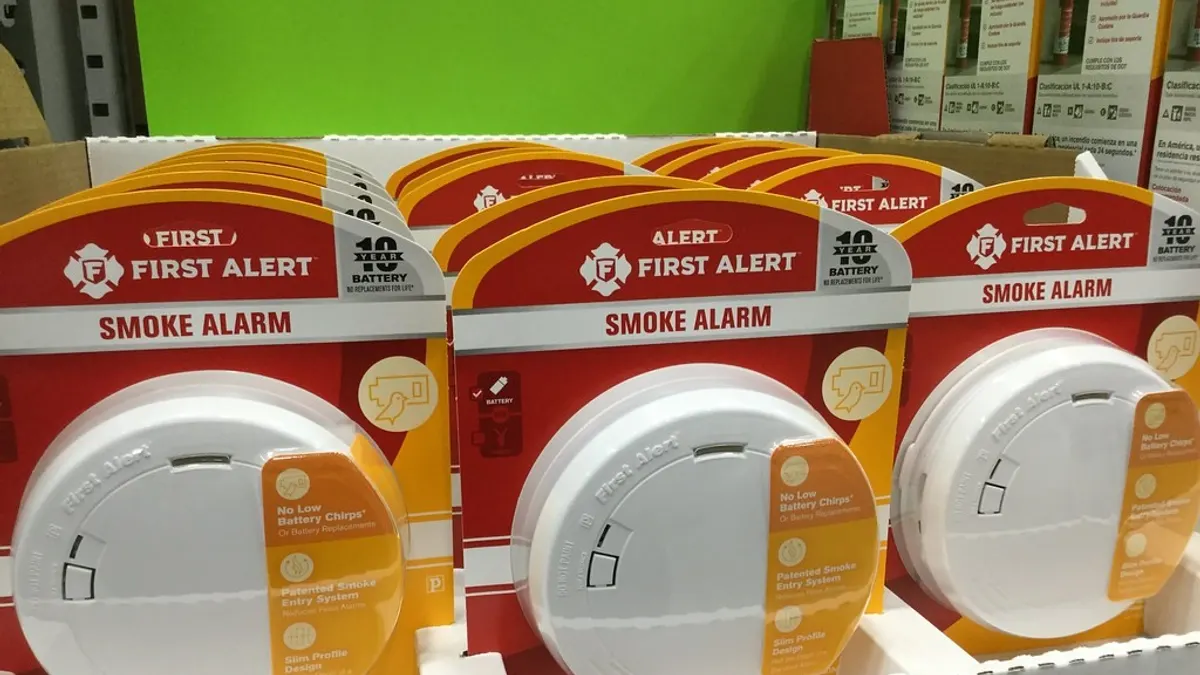
The USFA recommends smoke alarms inside and outside each bedroom and sleeping area and on every level of the home, interconnected so that when one sounds they all sound. Test them monthly, replace batteries at least yearly (unless sealed 10-year units), and replace the alarm 10 years from its manufacture date. If your enclosures are in a room without one, adding an alarm there is cheap insurance.
Safety checklist
| Check | How often |
|---|---|
| Every heater runs through a thermostat rated above the total load | At setup and whenever you add a heater |
| Probe secure at the basking spot or above the mat; reading matches a separate thermometer | Weekly |
| Bulbs fully seated in ceramic sockets; fixture rating above bulb wattage | At every bulb change |
| Guards on any lamp inside the enclosure | At setup |
| Heat mat: no cracking, blistering or discoloration; tank still lifted on its feet | Monthly |
| Cords undamaged, not under rugs; no overloaded strips | Monthly |
| Smoke alarm tested | Monthly (USFA) |
For the gear itself, see the best reptile heat lamps and the best thermometers for checking a thermostat's work. The electricity cost calculator shows what a setup draws. Care needs differ by species; ask a reptile veterinarian about your animal's temperatures.
Frequently asked questions
Do I need a thermostat for a reptile heat lamp?
Yes. Arcadia says its heat lamps should be used with a thermostat and recommends dimming thermostats with probes for halogen and deep heat lamps. A thermostat holds the basking spot at the temperature you set and cuts power when it gets too hot; a lamp on its own just runs at full output.
Do heat mats need a thermostat?
Run them through one. BN-LINK sells its 8 x 12 inch mat as giving steady heat between 104 and 122 degrees F, and Zoo Med says its under tank heater operates around 95 to 100 degrees F. Zoo Med tells owners to use a thermostat or unplug the mat if the house goes above 80 degrees F; a thermostat handles both cases without you being there.
Can a reptile heat lamp start a fire?
Heat lamps and their wiring are a fire risk when misused. Zoo Med's fixture instructions warn of fire risk if the electrical rating is exceeded or the fixture is covered, and say a loose bulb can cause arcing. Use a ceramic-socket fixture rated above the bulb, keep anything that can burn away from it, and have working smoke alarms.
Can I use a ceramic heat emitter in any dome lamp?
No. Some fixtures exclude them: Zoo Med's Deep Dome Lamp Fixture is marked not for use with ceramic heat emitters, while its ceramic emitters are UL listed for use in its Wire Cage Clamp Lamp with a porcelain socket. Check the fixture's instructions and wattage rating before fitting one.
Can I put a heat mat under a PVC enclosure?
Zoo Med says its full-size ReptiTherm mats are for glass terrariums only and excludes plastic, wood, acrylic and foam cages from the warranty. Many PVC enclosures are heated from above instead. Check your enclosure maker's instructions before attaching any heater.
Is a rheostat the same as a thermostat?
No. Zoo Med explains that a rheostat is basically a dimmer that manually reduces power, while a thermostat senses the temperature and turns the heater on and off, or dims it, to hold a set point. A rheostat cannot respond when the room temperature changes.
Sources
- Appliance and Electrical Fire Safety, U.S. Fire Administration
- Smoke Alarms, U.S. Fire Administration
- ReptiTherm U.T.H. instructions (RH-4, 5, 6 and Mini), Zoo Med Laboratories
- ReptiTemp Digital Thermostat RT-600 instructions, Zoo Med Laboratories
- ReptiTemp 500R Remote Sensor Thermostat (FAQ), Zoo Med Laboratories
- Deep Dome Lamp Fixture LF-17 instructions, Zoo Med Laboratories
- ReptiCare Ceramic Infrared Heat Emitter instructions, Zoo Med Laboratories
- Deep Heat Projector, Arcadia Reptile
- Heat Lamp Cage, Arcadia Reptile
- Herpstat 1 and 2 User Manual, Spyder Robotics
Cover photo: First Alert Smoke Detector Alarm, Pics by Mike Mozart! by JeepersMedia, CC BY 2.0, via Flickr. Cropped.
Related guides
Reptile Temperature and UVB Chart: Basking, Day and Night Temps for 59 Species
A searchable chart of 59 lizards, snakes, tortoises and turtles: basking surface, daytime and night temperatures, UVB zone and, where Merck covers them, humidity and diet.
Best Reptile Heat Lamps of 2026: Halogen, Deep Heat and Ceramic
Basking lamps for daytime heat and light-free heaters for night, chosen on the makers' specs and fixture requirements.
Best Reptile Heat Mats of 2026: Under Tank Heaters Compared
Under tank heaters compared on size, wattage and the makers' mounting rules, plus why each needs a thermostat.