
Reptile Electricity Cost Calculator: What Your Lamps and Heaters Cost
Affiliate disclosure: product links on this page go to Amazon, or to the maker's own store for brands that sell only direct. As an Amazon Associate we earn from qualifying purchases, at no extra cost to you; a link to a maker's store earns us nothing. No retailer or brand sees our picks before they are published or has any say in them. How we choose.
Enter each lamp and heater's rated watts, the hours it runs and the share of its power it draws on average, and the calculator gives the cost per day, month and year at your electricity rate. With the defaults (a 75-watt basking lamp and a 24-watt T5 UVB tube, each on for 12 hours, at the US average residential rate of 18.3 cents per kWh) a basic setup costs at most about $6.61 a month, or $79 a year.
The defaults are deliberately the ceiling: every heater is set to draw its full rated power. A dimming or pulse thermostat holds a lamp below that, so your real figure should be lower. The method and every default, with its source, are explained under the calculator.
Reptile enclosure electricity cost
Default: US residential average, July 2026 (EIA). Use the rate on your bill.
Per month
$6.61
36.1 kWh
Per year
$79
434 kWh
Per day
1.19 kWh
$0.22
Energy per device = rated watts x hours on x average power share. A dimming or pulse-proportional thermostat cuts a heater's average draw below its rating; an on/off thermostat switches it off part of the time. Use the rate on your own bill.
How the calculator works
Each device's daily energy is its rated watts, times the hours it is on, times the average share of that power it draws, divided by 1,000 to give kilowatt-hours (kWh). The calculator adds the devices, multiplies by 30.4 days for a month and 365 for a year, and multiplies the energy by your rate.
| Step | Formula | Default example |
|---|---|---|
| Basking lamp | 75 W x 12 h x 100% / 1,000 | 0.900 kWh a day |
| UVB lamp | 24 W x 12 h x 100% / 1,000 | 0.288 kWh a day |
| Total per day | Sum of devices | 1.188 kWh |
| Per month | 1.188 kWh x 30.4 days | 36.1 kWh |
| Cost per month | 36.1 kWh x $0.183 | $6.61 |
| Cost per year | 1.188 kWh x 365 x $0.183 | $79.35 |
The defaults and where they come from
| Input | Default | Why |
|---|---|---|
| Basking lamp watts | 75 W | Arcadia's 75-watt PAR30 halogen flood is the lamp Arcadia calls its most popular halogen heating lamp, and the one in its Optimal Heating Pack. |
| Basking lamp hours | 12 h | Arcadia advises grouping heat and light over the basking zone, so the lamp runs for the same day length as the UVB lamp (below). |
| Basking lamp power share | 100% | The most the lamp can draw. A thermostat lowers it by an amount that depends on your room and enclosure, so we start at the ceiling; lower it if your thermostat shows the power it applies. |
| UVB lamp watts | 24 W | The standard 22-inch T5 HO tube: Arcadia's 22-inch T5 lamps and Zoo Med's 22-inch ReptiSun T5 HO are both 24 watts. |
| UVB lamp hours | 12 h | Zoo Med's UVB guidance refers to lamps used 10 to 12 hours a day; we use the upper end. |
| UVB power share | 100% | Fluorescent UVB lamps are not dimmed or thermostat-controlled; Zoo Med says its ReptiSun lamps need line voltage and cannot be used with its thermostats. |
| Night heat | 0 W | Set to zero unless your room gets colder than your species' night range. If it does, enter the heater's watts: Arcadia's Deep Heat Projector is 50 or 80 W, Zoo Med's ceramic emitters 60, 100 or 150 W. |
| Other devices | 0 W | Misters, foggers, fans and plant lights vary too much for a default; enter the watts printed on the device or its adapter. |
| Electricity rate | 18.3 cents/kWh | US average residential price for July 2026 (18.31 cents), EIA Electric Power Monthly, Table 5.6.A, released September 24, 2026. The next release is due October 23, 2026. |
Worked examples
All figures at 18.3 cents per kWh. Device wattages are the makers' ratings; hours are what you would set on a timer. The power shares are the 100% ceiling unless stated.
| Setup | kWh per day | Per month | Per year |
|---|---|---|---|
| Defaults: 75 W lamp and 24 W T5, 12 h each | 1.188 | $6.61 | $79.35 |
| Same, but the thermostat shows the lamp averaging 50% power | 0.738 | $4.11 | $49.29 |
| Desert setup: 75 W halogen, 39 W Arcadia T5 and 50 W deep heat projector, 12 h each | 1.968 | $10.95 | $131.45 |
| Small gecko setup: 35 W halogen and 8 W ShadeDweller for 12 h, plus a 16 W heat mat for 24 h | 0.900 | $5.01 | $60.12 |
The second row shows why a proportional thermostat matters for running costs as well as safety: whatever share your lamp actually averages comes straight off its line in the bill.
Your electricity rate
Residential prices vary several-fold between states. The default setup above (1.188 kWh a day) costs:
| State | Cents per kWh | Default setup per month | Per year |
|---|---|---|---|
| Louisiana | 12.72 | $4.59 | $55.16 |
| US average | 18.31 | $6.61 | $79.35 |
| California | 33.61 | $12.14 | $145.74 |
| Hawaii | 48.00 | $17.34 | $208.14 |
Use the rate on your own bill, including delivery charges if your utility bills them per kWh.
Ways to lower the bill without cutting corners
- Use a proportional thermostat. A dimming thermostat on a basking lamp, or pulse control on a mat or emitter, delivers only the power needed to hold the set point. See our best reptile thermostats.
- Choose the right wattage. Arcadia advises a lower-wattage lamp with a beam wide enough to cover the animal over a larger lamp dimmed hard, and says its 35-watt halogen can for most replace a 75-watt standard tungsten lamp. Our best reptile heat lamps guide covers sizes.
- Put lights on a timer. Hours are the other half of the formula; a timer keeps the photoperiod exact.
- Do not skimp on UVB. A 24-watt tube on for 12 hours costs about $1.60 a month at the US average rate. Replace it on schedule; see the best UVB lights for reptiles.
Never save money by running a heater without a thermostat or with a guard removed; our heating safety guide explains why. If you are also building a planted enclosure, our guide on how to set up a bioactive enclosure covers the layers and what they need.
Frequently asked questions
How much does it cost to run a reptile heat lamp?
A 75-watt lamp on for 12 hours uses at most 0.9 kWh a day, about 27.4 kWh a month, which is about $5.01 a month at the July 2026 US average residential rate of 18.3 cents per kWh. Once the basking spot reaches its set point, a dimming thermostat holds the lamp below full power, so the real cost is lower.
How much does a UVB light cost to run?
A 24-watt T5 UVB tube on for 12 hours a day uses 0.288 kWh a day, about 8.8 kWh a month, or roughly $1.60 a month at 18.3 cents per kWh. UVB lamps run at full power because they are not dimmed or thermostat-controlled.
Does a thermostat save electricity?
A thermostat cuts a heater's average draw below its rating whenever the enclosure is at temperature. If a 75-watt lamp averages 50% power, the default setup drops from $6.61 to $4.11 a month at the US average rate. Some thermostats show the power they are applying, which you can enter as the power share.
What electricity rate should I use?
The one on your bill. The default is the US average residential price for July 2026, 18.31 cents per kWh, from EIA Electric Power Monthly Table 5.6.A. State averages that month ranged from 12.72 cents in Louisiana to 48.00 cents in Hawaii.
Do heat mats use much electricity?
Not much, because they are low wattage. A 16-watt heat mat on for 24 hours uses at most 0.384 kWh a day, about 11.7 kWh a month, or about $2.14 a month at 18.3 cents per kWh. Run it through a thermostat for safety, which also lowers the average.
Sources
- Electric Power Monthly, Table 5.6.A. Average Price of Electricity to Ultimate Customers by End-Use Sector, by State (July 2026), U.S. Energy Information Administration
- Halogen Infrared Heater, Arcadia Reptile
- Optimal Heating Pack, Arcadia Reptile
- D3+ Desert 12% UV-B lamp (T5 wattages), Arcadia Reptile
- T5 HO ReptiSun 10.0 UVB (lamp wattages), Zoo Med Laboratories
- Reptiles and UVB, Zoo Med Laboratories
- ReptiTemp 500R Remote Sensor Thermostat (FAQ on ReptiSun lamps), Zoo Med Laboratories
- The Light and Shade Method, Arcadia Reptile
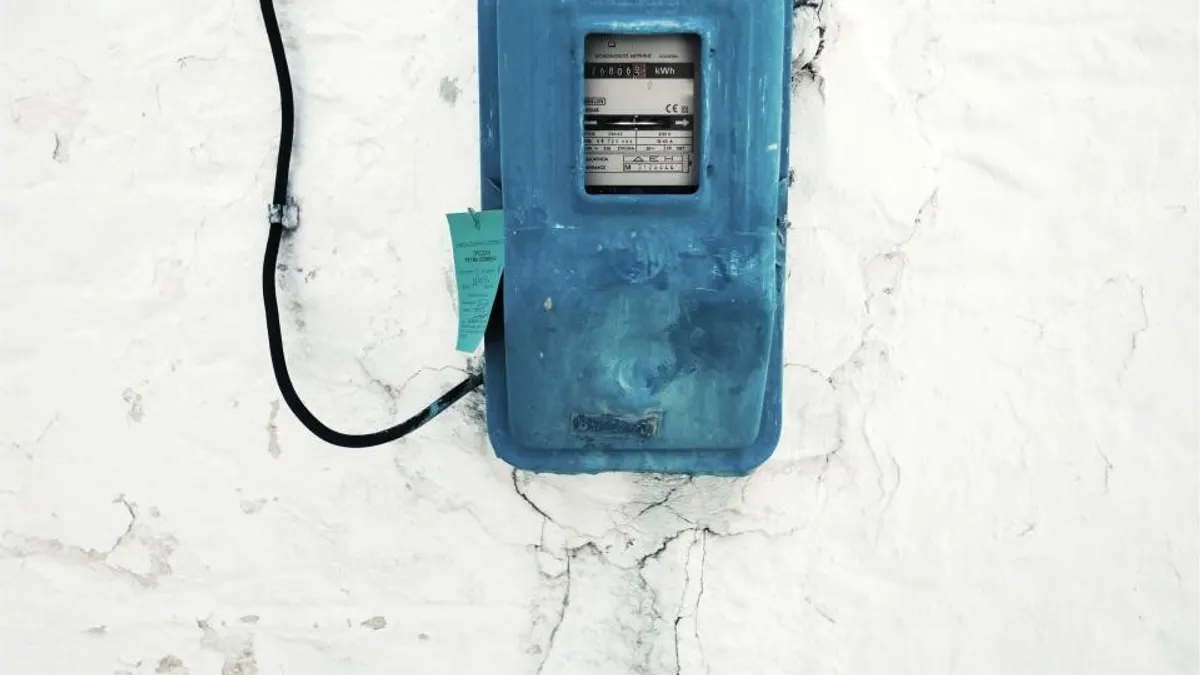
Cover photo: Hydro Meter by taner ardalı, CC0 1.0, via StockSnap. Cropped.
Related guides
Bioactive Substrate Calculator: How Many Quarts and Bags You Need
Quarts, liters and bags of substrate and drainage for any enclosure, with the method and defaults explained.
Best Reptile Heat Lamps of 2026: Halogen, Deep Heat and Ceramic
Basking lamps for daytime heat and light-free heaters for night, chosen on the makers' specs and fixture requirements.
Best Reptile Heat Mats of 2026: Under Tank Heaters Compared
Under tank heaters compared on size, wattage and the makers' mounting rules, plus why each needs a thermostat.