
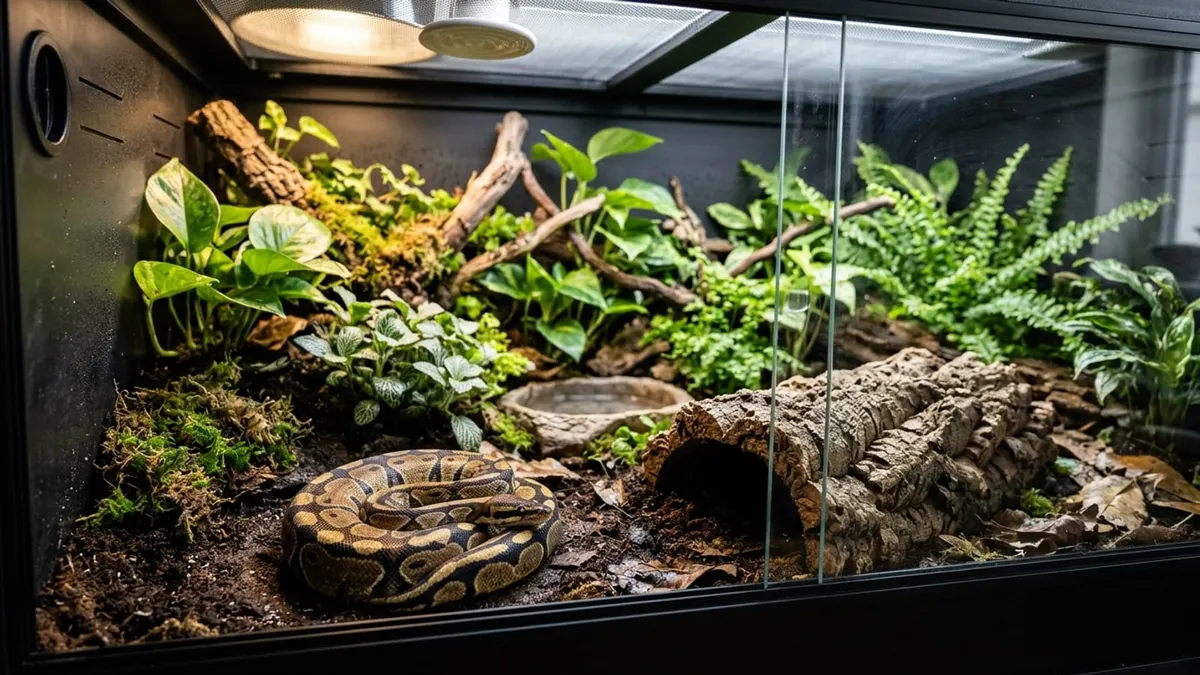
Best Ball Python Enclosures of 2026: 4x2x2, 6x2x2 and Juvenile Picks
Affiliate disclosure: product links on this page go to Amazon, or to the maker's own store for brands that sell only direct. As an Amazon Associate we earn from qualifying purchases, at no extra cost to you; a link to a maker's store earns us nothing. No retailer or brand sees our picks before they are published or has any say in them. How we choose.
The best ball python enclosure for most adults is the Reptile Habitats 4x2x2 V3, a 48 x 24 x 24 inch enclosure with PVC panels and glass doors, sold on Amazon by Dubia Roaches. By the RSPCA's rule (an enclosure at least as long as the snake, with width and height at least a third of its length), a 4x2x2 fits a ball python up to 4 feet. That covers most adults: VCA Animal Hospitals says they generally grow no longer than 3 to 5 feet.
Females grow larger than males, to about 1.5 meters (59 inches) per Animal Diversity Web, and a snake that size needs at least 5 feet of length. For her, buy the Reptile Habitats 6x2x2 once instead of upgrading later.
This guide is for keepers buying a permanent home for an adult ball python or a first enclosure for a young one. Picks are based on the size and housing guidance of the RSPCA, VCA and the Merck Veterinary Manual, and on what the makers and listings publish, checked November 13, 2026.
Our top picks at a glance
1. Best overall
Reptile Habitats 4x2x2 (120 Gallon) PVC Enclosure V3Size (L x W x H): 48 x 24 x 24 in · Panels: PVC, aluminum frame · Doors: Glass · Fits a snake up to: 4 ft (RSPCA rule)
2. Best for a large female
Reptile Habitats 6x2x2 (180 Gallon) PVC Enclosure V3Size (L x W x H): 72 x 24 x 24 in · Panels: PVC, aluminum frame · Doors: Glass · Fits a snake up to: 6 ft (RSPCA rule)
3. Best low-profile
Zen Habitat 3.0 4' x 2' x 16" PVC EnclosureSize (L x W x H): 48 x 24 x 16 in · Panels: PVC · Doors: Acrylic, front-sliding, removable · Fits a snake up to: 4 ft (RSPCA rule)
4. Best for stacking
Phailozoo REPMAC 120 Gallon 4x2x2 EnclosureSize (L x W x H): 48 x 24 x 24 in · Panels: Composite PVC and acrylic (clear sides) · Doors: Tempered glass, sliding · Fits a snake up to: 4 ft (RSPCA rule)
5. Best for a juvenile
REPTI ZOO 50 Gallon PVC Enclosure (36 x 18 x 18 in)Size (L x W x H): 36 x 18 x 18 in · Panels: PVC · Doors: Tempered glass, sliding, with lock · Fits a snake up to: 3 ft (RSPCA rule)
| Pick | Size (L x W x H) | Panels | Doors | Fits a snake up to | Buy |
|---|---|---|---|---|---|
| Reptile Habitats 4x2x2 (120 Gallon) PVC Enclosure V3Best overall | 48 x 24 x 24 in | PVC, aluminum frame | Glass | 4 ft (RSPCA rule) | Amazon |
| Reptile Habitats 6x2x2 (180 Gallon) PVC Enclosure V3Best for a large female | 72 x 24 x 24 in | PVC, aluminum frame | Glass | 6 ft (RSPCA rule) | Amazon |
| Zen Habitat 3.0 4' x 2' x 16" PVC EnclosureBest low-profile | 48 x 24 x 16 in | PVC | Acrylic, front-sliding, removable | 4 ft (RSPCA rule) | Amazon |
| Phailozoo REPMAC 120 Gallon 4x2x2 EnclosureBest for stacking | 48 x 24 x 24 in | Composite PVC and acrylic (clear sides) | Tempered glass, sliding | 4 ft (RSPCA rule) | Amazon |
| REPTI ZOO 50 Gallon PVC Enclosure (36 x 18 x 18 in)Best for a juvenile | 36 x 18 x 18 in | PVC | Tempered glass, sliding, with lock | 3 ft (RSPCA rule) | Amazon |
Best overall
Reptile Habitats 4x2x2 (120 Gallon) PVC Enclosure V3
An all-PVC 4x2x2 with glass doors that meets the RSPCA size rule for a ball python up to 4 feet, which covers most adults.
- Size (L x W x H)
- 48 x 24 x 24 in
- Panels
- PVC, aluminum frame
- Doors
- Glass
- Fits a snake up to
- 4 ft (RSPCA rule)
- Top
- Heavy-duty screen
Pros
- PVC panels the listing says are not damaged by high humidity, which suits a snake kept at 50 to 80%
- 8 square feet of floor: by the Merck Veterinary Manual's figure, enough for a python up to about 1.24 meters (4.1 feet)
- The listing says it assembles in under 30 minutes
Cons
- Shown as limited stock on Amazon when we checked
- The listing gives two weights: 25 pounds in its bullet points and 36 pounds in its specs
- The listing mentions no door lock, so plan on adding one
The Reptile Habitats V3 is a flat-pack enclosure of PVC panels in an aluminum frame, with glass doors and a heavy-duty screen top, sold on Amazon by Dubia Roaches, whose FAQ covers its own 4x2x2 PVC enclosures. That FAQ gives the inside of the earlier V1 and V2 models as about 47.5 x 23.5 x 23.5 inches. It lists no V3 figure, and the Amazon listing's model field still reads V2.
For a ball python the size is right. The RSPCA's rule puts a 4 foot snake in at least 48 x 16 x 16 inches, and the Merck figure of 0.6 square meters of floor per meter of snake comes to about 7.9 square feet for the same snake. The screen top is the part to manage: the RSPCA wants 50 to 60% humidity at the cool end, and open mesh lets moisture out. Hold it with substrate and a humid hide rather than by covering the mesh (the buying guide below explains why).
Skip the Reptile Habitats 4x2x2 if your snake is a large female heading past 4 feet; the 6x2x2 below costs more now and saves buying twice.
Best for a large female
Reptile Habitats 6x2x2 (180 Gallon) PVC Enclosure V3
Six feet of length meets the RSPCA rule for a snake up to 6 feet, so a 5 foot female can stretch out with room to spare.
- Size (L x W x H)
- 72 x 24 x 24 in
- Panels
- PVC, aluminum frame
- Doors
- Glass
- Fits a snake up to
- 6 ft (RSPCA rule)
- Top
- Heavy-duty screen
Pros
- 12 square feet of floor, 50% more than a 4x2x2; by Merck's figure, enough for a python up to about 1.86 meters (6.1 feet)
- Same PVC and aluminum build as the 4x2x2, which the listing says is not affected by humidity
- More length between the RSPCA's 30 to 32°C (86 to 90°F) basking end and its 24 to 26°C (75 to 79°F) cool end
Cons
- The listing gives no weight and no inside dimensions
- Shown as limited stock on Amazon when we checked
- Needs a 6 foot stand or a clear stretch of floor
Ball python females grow larger than males: Animal Diversity Web gives adults 1 to 1.5 meters and says the difference shows only once they are grown, and the RSPCA says royal pythons can reach around 150 cm. A 150 cm (59 inch) snake needs at least 59 x 20 x 20 inches by the RSPCA's rule, more than a 4x2x2 offers. This Reptile Habitats V3 is the 6 foot version of the top pick, with PVC panels, an aluminum frame, a heavy-duty screen top and glass doors, per the Amazon listing, sold by Dubia Roaches.
A 5x2x2 meets the same rule for a 150 cm snake with an inch to spare, and the Reptile Habitats 5x2x2 costs less. The 6 foot model buys margin: room for a snake that ends up longer than expected, and a temperature gradient spread over 6 feet. The RSPCA asks for a UVB tube one half to one third of the enclosure's length, which is 24 to 36 inches here.
Skip the Reptile Habitats 6x2x2 if your snake is a grown male under 4 feet; the 4x2x2 already meets both size figures for him. The listing gives no weight, so ask the seller before you choose a stand.
Best low-profile
Zen Habitat 3.0 4' x 2' x 16" PVC Enclosure
A 16 inch tall PVC enclosure that still meets the RSPCA rule for a snake up to 4 feet, for shelves and stacks where 24 inches will not fit.
- Size (L x W x H)
- 48 x 24 x 16 in
- Panels
- PVC
- Doors
- Acrylic, front-sliding, removable
- Fits a snake up to
- 4 ft (RSPCA rule)
- Weight
- 46 lb (per the Amazon listing)
Pros
- The same 8 square foot floor as a 4x2x2 in two thirds of the height
- Sold on Amazon by Zen Habitats itself
- Front-sliding acrylic doors that come out, per the listing
Cons
- 16 inches is exactly the RSPCA minimum height for a 4 foot snake, so it does not suit a large female
- Less room between a lamp on the mesh and the snake's highest perch
- Heavier than the 4x2x2 picks, at 46 pounds (per the Amazon listing)
Ball pythons spend most of their time on or under the ground, in burrows, according to Animal Diversity Web, so floor matters more than height, and the RSPCA's rule asks only for height of a third of the snake's length. Zen's 4' x 2' x 16" enclosure keeps the 48 x 24 inch floor of a 4x2x2 and cuts the height to 16 inches, which still meets that rule for a snake up to 48 inches. The listing gives PVC panels and front-sliding acrylic doors that come out.
The lower roof changes how you heat it. VCA wants a heat bulb at least 4 to 6 inches above the highest spot a snake can reach, so with 4 inches of substrate and a 6 inch tall hide, about 6 inches are left under the mesh. Keep climbing decor low and run every heater through a thermostat; our heat lamp guide compares ceramic emitters and deep heat projectors for this kind of setup.
Skip the Zen 4' x 2' x 16" for a large female or any snake that will pass 4 feet. Zen also makes a 4 x 2 x 2 foot PVC enclosure, sold through its own site; our PVC enclosure guide covers it.
Best for stacking
Phailozoo REPMAC 120 Gallon 4x2x2 Enclosure
A 4x2x2 that stacks with Phailozoo's own spacers, up to three high per PetSmart's listing, for keepers housing more than one snake.
- Size (L x W x H)
- 48 x 24 x 24 in
- Panels
- Composite PVC and acrylic (clear sides)
- Doors
- Tempered glass, sliding
- Fits a snake up to
- 4 ft (RSPCA rule)
- Weight
- 38.4 lb (PetSmart) or 44 lb (Amazon listing)
Pros
- Stacks with Phailozoo's V2 stackers; PetSmart's listing recommends no more than 3 tiers
- A steel mesh top the Amazon listing says blocks only 28% of light, which matters for a UVB tube on the mesh
- 1-year manufacturer warranty, per the Amazon listing
Cons
- The listing says the silicone bottom seal is for strength only and is not leakproof
- Clear acrylic ends leave a shy snake fewer covered walls
- The stackers fit only Phailozoo enclosures, per the listing
Phailozoo's 120 gallon REPMAC is the stacking pick. Its Amazon listing says it stacks with the brand's patented V2 stackers, which fit no other brand, and PetSmart's listing recommends no more than three tiers. That suits a keeper with two or three snakes and one wall. PetSmart lists an aluminum frame with composite PVC and acrylic panels, including two clear acrylic sides, and a rust-proof steel mesh top; the Amazon listing gives sliding tempered glass doors.
Two cautions. The bottom is sealed for strength only: the listing says it is not leakproof and that a bioactive build must be sealed again with silicone, 2 to 3 cm above the substrate line. And the clear ends let light and movement in on both sides. Animal Diversity Web notes that ball pythons seek cover to avoid predators, and the RSPCA asks for several hides at both ends, so add a hide or a background. Our hide guide lists snake caves by size.
Skip the Phailozoo if you keep one snake and want opaque sides; the Reptile Habitats 4x2x2 has PVC panels and costs less.
Best for a juvenile
REPTI ZOO 50 Gallon PVC Enclosure (36 x 18 x 18 in)
A 3 foot PVC enclosure with a locking door for a young ball python, meeting the RSPCA rule for a snake up to 3 feet.
- Size (L x W x H)
- 36 x 18 x 18 in
- Panels
- PVC
- Doors
- Tempered glass, sliding, with lock
- Fits a snake up to
- 3 ft (RSPCA rule)
- Warranty
- 90 days (per the Amazon listing)
Pros
- The only pick whose Amazon listing mentions a door lock
- PVC that the listing calls more moisture-resistant than wood, with a detachable mesh top
- The lowest price of the five when we checked on November 13, 2026
Cons
- Outgrown at 3 feet by the RSPCA rule, and at about 0.7 meters (2.3 feet) by Merck's floor figure
- A 90-day warranty, the shortest here
- REPTI ZOO lists no inside dimensions
Ball pythons hatch at 25 to 43 cm (10 to 17 inches), per Animal Diversity Web, and VCA says smaller or juvenile snakes can start in a 10 to 20 gallon aquarium and move up as they grow. This 36 x 18 x 18 inch REPTI ZOO enclosure is a step past that in PVC: it meets the RSPCA rule for a snake up to 36 inches, and the Merck Veterinary Manual calls glass a poor insulator whose heat loss can cause large temperature swings.
REPTI ZOO's listing gives a PVC body, a tempered glass sliding door with a safety lock and a detachable mesh top. The lock matters: VCA says every snake cage must be escape-proof, with sealed seams and a secure top that locks. The listing's warranty is 90 days.
Skip the REPTI ZOO if you would rather buy once. VCA advises the largest cage possible, and a young snake can go straight into a 4x2x2 if it has plenty of cover; the RSPCA asks for several hides at both ends. By Merck's floor figure this enclosure is outgrown at about 0.7 meters, so plan the move before the snake reaches 2 to 3 feet.
How we chose
Size came first, from veterinary and welfare guidance rather than the makers' species labels. Four sources give figures for ball pythons, and the RSPCA's rule and the Merck floor figure turn a snake's length into a minimum enclosure:
| Source | Guidance | What it means |
|---|---|---|
| RSPCA | Length at least the snake's length; width and height at least one third of it | 4 ft snake: 48 x 16 x 16 in. 5 ft snake: 60 x 20 x 20 in |
| Merck Veterinary Manual | 0.6 square meters of floor per meter of snake (boas and pythons) | 4 ft (1.22 m) snake: 0.73 m² (7.9 sq ft). 5 ft (1.52 m): 0.91 m² (9.8 sq ft) |
| VCA Animal Hospitals | Adults generally no longer than 3 to 5 ft (90 to 150 cm); the largest cage possible, escape-proof with a top that locks | A 4x2x2 for most adults, more for the longest |
| Animal Diversity Web | Adults 1 to 1.5 m; females larger than males; hatchlings 25 to 43 cm | Size the enclosure for the snake's sex and adult length |
Then we compared what the makers and listings publish: panel material, door type, locks, weight, stacking and how the base is sealed. All five picks were in stock on Amazon US when we checked on November 13, 2026.
Which ball python enclosure fits which snake
The table below runs the RSPCA rule and the Merck figure on each pick's size. A snake meets the RSPCA rule when its length is no more than the enclosure's length and no more than three times its width or height.
| Enclosure (L x W x H) | Floor | RSPCA rule: snake up to | Merck figure: snake up to | Pick |
|---|---|---|---|---|
| 36 x 18 x 18 in | 4.5 sq ft (0.42 m²) | 3 ft (36 in) | About 0.70 m (2.3 ft) | REPTI ZOO 50 Gallon PVC |
| 48 x 24 x 16 in | 8 sq ft (0.74 m²) | 4 ft (48 in) | About 1.24 m (4.1 ft) | Zen 4' x 2' x 16" |
| 48 x 24 x 24 in | 8 sq ft (0.74 m²) | 4 ft (48 in) | About 1.24 m (4.1 ft) | Reptile Habitats 4x2x2, Phailozoo 120 |
| 60 x 24 x 24 in | 10 sq ft (0.93 m²) | 5 ft (60 in) | About 1.55 m (5.1 ft) | Reptile Habitats 5x2x2 |
| 72 x 24 x 24 in | 12 sq ft (1.11 m²) | 6 ft (72 in) | About 1.86 m (6.1 ft) | Reptile Habitats 6x2x2 |
These figures use outside dimensions. Inside measurements run a little smaller: Dubia Roaches gives about 47.5 x 23.5 x 23.5 inches inside its 4x2x2. Our reptile enclosure size guide has the same comparison for other species.
Buying guide
PVC over glass and wood
A ball python needs humidity of 50 to 80% (Merck) and a warm end of 30 to 32°C (86 to 90°F) with a cool end of 24 to 26°C (75 to 79°F) (RSPCA). The Merck Veterinary Manual calls glass a poor insulator and says wood, plastic and fiberglass enclosures are preferable; VCA's snake housing sheet warns that wooden cages are very difficult to clean and disinfect. PVC answers both points, which is why every pick here uses PVC panels.
Hold humidity without sealing the top
An open screen top lets humidity escape, and the tempting fix is to cover it. The Merck manual says reducing ventilation to hold temperature and humidity is ill advised, and the RSPCA says an enclosure where humidity stays too high needs more ventilation. Hold humidity from below instead: the RSPCA recommends organic reptile soils, which hold humidity without going moldy, and misting that raises humidity to around 80% before letting it fall. Measure at the cool end, where the RSPCA wants 50 to 60%.
Heat and where the lamp goes
The RSPCA heats one end of a ball python enclosure with a 60 to 100 watt reptile heat lamp pointing down, behind a guard and on a thermostat, and uses a ceramic heater or reptile radiator at night; the Merck manual adds that light bulbs cannot provide night heat and that heaters should be thermostat controlled and screened from the animal. On a screen-top enclosure the lamp sits on the mesh, outside the snake's reach, which is what VCA recommends, with at least 4 to 6 inches between the bulb and the highest spot the snake can climb to. If you use a heat mat instead, the RSPCA puts it under the enclosure or behind a mat guard, on an on/off thermostat set at 32°C with the probe over the mat.
UVB through the mesh
The RSPCA asks for a low-output 2 to 7% UVB tube, one half to one third of the enclosure's length, giving a UV index of 1.0 at the basking zone and zero in the shade (0.7 at most for albino morphs). That is a 16 to 24 inch tube on a 4 foot enclosure and 24 to 36 inches on a 6 foot one. Most transparent plastic and glass filter out UVB (Merck), so the tube works through the mesh top, not the doors, and the mesh blocks part of it: Phailozoo's listing puts its screen at 28%. Our UVB light guide compares tubes and kits.
Locks, seams and weight
VCA says every snake cage must be well ventilated and escape-proof, with sealed seams and a secure top that locks. Of the five Amazon listings here, only REPTI ZOO's mentions a door lock, so budget for a sliding-door lock on the others. The listings that give a weight put these enclosures at 25 to 46 pounds empty, before substrate, decor and a full water bowl, so use a stand rated for the total.
What to skip
- A glass aquarium with a mesh lid for an adult. VCA treats 10 to 20 gallon aquariums as starter homes for small or juvenile snakes, and the Merck manual calls glass a poor insulator.
- Wood-panel enclosures. VCA says wooden cages are very difficult to clean and disinfect, and a ball python is kept at 50 to 80% humidity.
- Buying by gallons alone. Gallons describe volume, not floor or length. Phailozoo's own listing says its 36 x 18 x 18 inch "50 gallon" enclosure holds 40 gallons inside. Check the length against your snake with the table above.
- Heat rocks. VCA calls hot rocks dangerous and ineffective, and the Merck manual says they frequently burn larger animals.
- Cedar shavings and sand. VCA says cedar shavings are toxic to reptiles, and the RSPCA advises against sand for royal pythons because it can irritate the skin.
What else a ball python enclosure needs
The enclosure is the biggest purchase. A ball python also needs a heat source on a thermostat, a digital thermometer at each end, a hygrometer at the cool end, hides at both ends and a moisture-holding substrate. Our ball python enclosure setup guide lists each item with the temperatures, humidity and UV levels the sources give.
Frequently asked questions
What size enclosure does a ball python need?
The RSPCA says the enclosure should be at least as long as the snake, with width and height of at least a third of its length, so a 4 foot snake needs at least 48 x 16 x 16 inches. VCA says adults generally grow no longer than 3 to 5 feet, so a 4x2x2 suits most adults and a large female needs 5 or 6 feet of length.
Is a 4x2x2 big enough for a ball python?
Yes, for a snake up to 4 feet. A 4x2x2 meets the RSPCA rule to 48 inches and the Merck Veterinary Manual's figure of 0.6 square meters of floor per meter of snake to about 1.24 meters. Females can reach about 1.5 meters (59 inches), which needs at least a 5x2x2.
Is a 40 gallon tank big enough for a ball python?
Only for a young snake. VCA treats 10 to 20 gallon aquariums as starter homes for small or juvenile snakes and advises the largest cage possible. A tank with a 36 inch floor meets the RSPCA rule only for a snake up to 3 feet, and VCA puts most adults at up to 3 to 5 feet.
Is PVC or glass better for a ball python?
PVC, for most keepers. The Merck Veterinary Manual calls glass a poor insulator that can cause large temperature swings and says plastic, wood and fiberglass enclosures are preferable. VCA warns that wooden cages are very difficult to clean and disinfect, which leaves PVC for a snake kept at 50 to 80% humidity.
Can a baby ball python live in a 4x2x2?
VCA says juvenile snakes can start in a 10 to 20 gallon aquarium but advises the largest cage possible, and sets no maximum. If a young snake goes straight into a 4x2x2, give it plenty of cover: the RSPCA asks for several hides at both ends so the snake can choose its temperature without leaving cover.
How tall should a ball python enclosure be?
The RSPCA asks for height of at least a third of the snake's length, so 16 inches covers a 4 foot snake and 20 inches a 5 foot one. Ball pythons live mostly on or under the ground, so length and floor matter more. Leave at least 4 to 6 inches between a heat bulb and the highest spot the snake can reach, as VCA advises.
Does a ball python enclosure need a lock?
Yes. VCA says every snake cage must be escape-proof, with sealed seams and a secure top that locks. Of the enclosures in this guide, only the REPTI ZOO 50 Gallon PVC's Amazon listing mentions a door lock, so add a sliding-door lock to the others.
Sources
- How To Care For a Royal Python, RSPCA
- Snakes: Housing, VCA Animal Hospitals
- Snakes: Constrictor, VCA Animal Hospitals
- Management and Husbandry of Reptiles, Merck Veterinary Manual
- Python regius (ball python), Animal Diversity Web, University of Michigan Museum of Zoology
- 4' x 2' x 2' PVC Enclosures, Dubia Roaches
- PHAILOZOO 120 Gallon Reptile Terrarium 4 ft x 2 ft x 2 ft Stackable Enclosure, PetSmart
Cover image: Illustration: Reptile Gear Review (AI-generated)
Related guides
Ball Python Enclosure Setup: Size, Heat, Humidity and Hides
Length to match the snake, a 30 to 32°C warm end, 50 to 60% humidity and tight, dark hides at both ends: the ball python setup with its sources.
Bearded Dragon Enclosure Setup: Size, Heat, UVB and Substrate
A 4x2x2 minimum, a 100 to 108°F basking spot, a UV index of 3 to 5 under the lamp and a dry cool end: the setup, figure by figure, with sources.
Best Bearded Dragon Enclosures of 2026: 4x2x2 and Bigger
A 4x2x2 is the floor for one adult bearded dragon. These are the enclosures that meet it, and the ones that go past it.