
Best UVB Lights for Reptiles of 2026, Matched to Ferguson Zones
Affiliate disclosure: product links on this page go to Amazon, or to the maker's own store for brands that sell only direct. As an Amazon Associate we earn from qualifying purchases, at no extra cost to you; a link to a maker's store earns us nothing. No retailer or brand sees our picks before they are published or has any say in them. How we choose.
For a bearded dragon or another desert basker, buy the Arcadia ProT5 Dragon 14% kit. Arcadia publishes exactly what it delivers (UVI 7.0 at 15 inches and 4.6 at 20 inches under its reflector), the lamp is rated for 12 months, and the 34-inch, 39-watt lamp runs most of the length of a 4-foot enclosure. For less money, Zoo Med's 24-inch ReptiSun T5 HO hood with the 10.0 lamp comes with Zoo Med's own distance chart. For leopard geckos, crested geckos and other shade dwellers, Arcadia's 8-watt ShadeDweller 7% kit gives the low UV those species need.
There is no single best UVB light, because the right one depends on the animal's Ferguson zone and the distance from lamp to animal. So we chose lamps whose makers publish UV Index (UVI) readings at distance, and matched each to the species it suits, using the zone guidance in Baines et al. (2016). If you are new to the zones, start with our Ferguson zones guide.
Our top picks at a glance
1. Best overall for bearded dragons and desert baskers
Arcadia ProT5 UVB Kit, Dragon 14%, 39W (34 in)UVB rating: 14% UVB, 30% UVA · Length / watts: 34 in lamp, 39W (kit 36 in) · UVI at 15 in: 7.00 (Arcadia, in reflector) · Best for zone: 3 to 4
2. Best value T5 kit
Zoo Med ReptiSun T5 HO Terrarium Hood with 10.0 Lamp, 24 inUVB rating: ReptiSun 10.0 · Length / watts: 22 in lamp, 24W, in a 24 in hood · UVI at 15 in: Zone 4 band (2.6 to 3.5+) from 10 to 19 in, per Zoo Med · Best for zone: 3 to 4 (zone 3 from 19 to 31 in)
3. Best for blue-tongued skinks, ball pythons and partial-sun species
Arcadia ProT5 UVB Kit, Forest 6%, 39W (34 in)UVB rating: 6% UVB, 30% UVA · Length / watts: 34 in lamp, 39W (kit 36 in) · UVI at 15 in: 3.60 (Arcadia, in reflector) · Best for zone: 2 to 3
4. Best for leopard geckos, crested geckos and other shade dwellers
Arcadia LumenIZE ProT5 ShadeDweller 7% kit, 8W (13 in)UVB rating: 7% (ShadeDweller lamp) · Length / watts: 13 in kit, 8W · UVI at 15 in: 0.45 (Arcadia, standard ShadeDwellerPro) · Best for zone: 1
5. Best replacement lamp for a 24-inch T5 hood
Zoo Med T5 HO ReptiSun 10.0 UVB lamp, 24W (22 in)UVB rating: ReptiSun 10.0 · Length / watts: 22 in, 24W (also 12, 34 and 46 in) · UVI at 15 in: Depends on fixture; see Zoo Med's chart · Best for zone: 3 to 4
| Pick | UVB rating | Length / watts | UVI at 15 in | Best for zone | Buy |
|---|---|---|---|---|---|
| Arcadia ProT5 UVB Kit, Dragon 14%, 39W (34 in)Best overall for bearded dragons and desert baskers | 14% UVB, 30% UVA | 34 in lamp, 39W (kit 36 in) | 7.00 (Arcadia, in reflector) | 3 to 4 | Amazon |
| Zoo Med ReptiSun T5 HO Terrarium Hood with 10.0 Lamp, 24 inBest value T5 kit | ReptiSun 10.0 | 22 in lamp, 24W, in a 24 in hood | Zone 4 band (2.6 to 3.5+) from 10 to 19 in, per Zoo Med | 3 to 4 (zone 3 from 19 to 31 in) | Amazon |
| Arcadia ProT5 UVB Kit, Forest 6%, 39W (34 in)Best for blue-tongued skinks, ball pythons and partial-sun species | 6% UVB, 30% UVA | 34 in lamp, 39W (kit 36 in) | 3.60 (Arcadia, in reflector) | 2 to 3 | Amazon |
| Arcadia LumenIZE ProT5 ShadeDweller 7% kit, 8W (13 in)Best for leopard geckos, crested geckos and other shade dwellers | 7% (ShadeDweller lamp) | 13 in kit, 8W | 0.45 (Arcadia, standard ShadeDwellerPro) | 1 | Amazon |
| Zoo Med T5 HO ReptiSun 10.0 UVB lamp, 24W (22 in)Best replacement lamp for a 24-inch T5 hood | ReptiSun 10.0 | 22 in, 24W (also 12, 34 and 46 in) | Depends on fixture; see Zoo Med's chart | 3 to 4 | Zoo Med |
Best overall for bearded dragons and desert baskers
Arcadia ProT5 UVB Kit, Dragon 14%, 39W (34 in)
The strongest T5 kit here, with published UVI figures that put a zone 4 basking spot at a practical 15 to 20 inches, even over mesh.
- UVB rating
- 14% UVB, 30% UVA
- Length / watts
- 34 in lamp, 39W (kit 36 in)
- UVI at 15 in
- 7.00 (Arcadia, in reflector)
- Best for zone
- 3 to 4
- Lamp life
- 12 months (Arcadia)
Pros
- Arcadia publishes UVI at 12, 15, 20 and 24 inches for this lamp
- Removable curved reflector; mounts inside a wooden or PVC enclosure or over mesh
- Links up to 10 units from one power source
- Flicker-free T5 with a CRI of 95, per Arcadia
Cons
- Too strong for zone 1 and 2 species at normal enclosure heights
- Arcadia rates the minimum lamp-to-animal distance at 10 inches, and calls 12 inches 'not advised' for this lamp
- Costs more than the Zoo Med hood
The ProT5 kit is Arcadia's T5 HO fitting with built-in electronics, a removable reflector, a power cable, fittings and a link cable, sold here with the 14% Dragon lamp. Arcadia's chart for the Dragon lamp under a ProT5 reads UVI 7.00 at 15 inches, 5.50 at 18 inches, 4.60 at 20 inches and 3.20 at 24 inches, measured with a Solarmeter 6.5. Arcadia sets the upper basking index for a bearded dragon (UVI 6) at about 15 inches from the lamp to the animal's back. That sits inside the UV-Tool's guidance for zone 4 species, which puts the best basking range at about UVI 3 to 5 and the absolute maximum under artificial UV at 7 to 8.
The extra output also matters over a mesh lid. Arcadia notes that stainless steel mesh can cut UVI by 30% or more, and Zoo Med says screen covers can filter up to 50% of UVB, so a strong lamp keeps the basking spot in range from outside the enclosure. The Amazon listing is the 39-watt, 34-inch lamp in a 36-inch fitting.
Who should skip it: owners of shade-dwelling species, and anyone whose animal can climb within about 12 inches of the lamp. For a smaller or lower-UV setup, the Arcadia Forest 6% or the Zoo Med 24-inch hood is a better fit.
Best value T5 kit
Zoo Med ReptiSun T5 HO Terrarium Hood with 10.0 Lamp, 24 in
A 24-inch T5 HO hood and 10.0 lamp with Zoo Med's own zone-by-distance chart, for smaller enclosures and tighter budgets.
- UVB rating
- ReptiSun 10.0
- Length / watts
- 22 in lamp, 24W, in a 24 in hood
- UVI at 15 in
- Zone 4 band (2.6 to 3.5+) from 10 to 19 in, per Zoo Med
- Best for zone
- 3 to 4 (zone 3 from 19 to 31 in)
- Warranty
- 1 year
Pros
- Zoo Med publishes a UVI distance chart for this exact hood (LF-76)
- Highly polished curved reflector inside the hood, per Zoo Med
Cons
- Zoo Med's chart gives distance bands, not UVI values at each distance
- A 22-inch lamp covers less of a 4-foot enclosure than a 34-inch one
- Animals must not get closer than 10 inches, where Zoo Med's chart reads above UVI 7
Zoo Med's 24-inch ReptiSun T5 HO hood (item LF-76) holds a 22-inch, 24-watt ReptiSun 10.0 lamp. Its distance chart reads: above UVI 7 closer than 10 inches (no animal access), zone 4 (UVI 2.6 to 3.5+) from 10 to 19 inches, zone 3 (1.0 to 2.6) from 19 to 31 inches, zone 2 from 31 to 36 inches and zone 1 from 36 to 38 inches. For a bearded dragon, that puts the basking platform 10 to 19 inches below the lamp; for a blue-tongued skink (zone 2 to 3 in the UV-Tool), lower.
Zoo Med calls its T5 HO lamps twice as strong as its standard ReptiSun lamps and sells the hood with a 1-year warranty. Replacement lamps are the same 22-inch T5 HO size.
Who should skip it: owners of 4-foot or longer enclosures who want UV across more of the floor (choose a 34-inch lamp), and owners of shade dwellers, for whom the 10.0 reaches zone 1 levels only at 36 to 38 inches.
Best for blue-tongued skinks, ball pythons and partial-sun species
Arcadia ProT5 UVB Kit, Forest 6%, 39W (34 in)
A gentler 6% T5 that reaches zone 2 to 3 levels at practical heights, for species that bask in partial sun.
- UVB rating
- 6% UVB, 30% UVA
- Length / watts
- 34 in lamp, 39W (kit 36 in)
- UVI at 15 in
- 3.60 (Arcadia, in reflector)
- Best for zone
- 2 to 3
- Lamp life
- 12 months (Arcadia)
Pros
- Arcadia publishes UVI of 4.50 at 12 in, 2.50 at 20 in and 1.20 at 24 in
- Same linkable ProT5 fitting and reflector as the Dragon kit
- Arcadia lists blue-tongued skinks, day geckos and chameleons among suitable species
Cons
- Not enough for a bearded dragon's basking spot at normal heights
- Still too strong for zone 1 species at 12 to 15 inches
- Few owner reviews on Amazon so far
The Forest kit is the same ProT5 fitting with Arcadia's 6% lamp. Arcadia's chart reads UVI 4.50 at 12 inches, 3.60 at 15, 2.90 at 18, 2.50 at 20 and 1.20 at 24, and Arcadia says the lamp without its reflector suits zones 1 to 2 while the reflected lamp suits zones 2 to 3. The UV-Tool appendix puts the eastern blue-tongued skink at zone 2 to 3 and the ball python (listed as royal python) at zone 2, whose maximum readings in the field were UVI 1.1 to 3.0.
For a ball python, that points to a basking spot around 20 to 24 inches from this lamp, or a mesh lid adding distance and filtering. For a blue-tongued skink, 15 to 20 inches gives readings inside the zone 3 maximum of 2.9 to 7.4.
Who should skip it: bearded dragon owners (choose the Dragon 14%), and leopard or crested gecko owners in low enclosures, who are better served by the ShadeDweller.
Best for leopard geckos, crested geckos and other shade dwellers
Arcadia LumenIZE ProT5 ShadeDweller 7% kit, 8W (13 in)
A short, 8-watt, low-output T5 built for zone 1 species, with Arcadia readings of UVI 0.65 at 12 inches on the standard kit.
- UVB rating
- 7% (ShadeDweller lamp)
- Length / watts
- 13 in kit, 8W
- UVI at 15 in
- 0.45 (Arcadia, standard ShadeDwellerPro)
- Best for zone
- 1
- Control
- LumenIZE app (dawn to dusk dimming)
Pros
- Designed around a basking distance of about 12 inches for crepuscular species
- App control lets it ramp up and down like dawn and dusk, per Arcadia
- Small enough for a 2-foot or 3-foot enclosure
Cons
- Arcadia's published UVI figures are for the standard ShadeDwellerPro; Arcadia says LumenIZE versions have increased output, so measure
- The app-controlled version costs more than a plain T5 fixture
- Mixed owner reviews and few of them on Amazon
Arcadia built ShadeDweller for crepuscular species such as leopard geckos, where the basking distance is about 12 inches. For the standard ShadeDwellerPro kit, Arcadia lists UVI 0.80 at 10 inches, 0.65 at 12, 0.45 at 15 and 0.30 at 18, measured without mesh, and notes stainless steel mesh can cut that by 30% or more. Those readings sit within the zone 1 maximum of UVI 0.6 to 1.4, and the UV-Tool assigns both the leopard gecko and the crested gecko to zone 1. It cites a study in which leopard geckos given low-level UVB had vitamin D3 metabolite levels 3.2 times those of geckos on dietary supplements alone.
The version on Amazon is the LumenIZE kit, Arcadia's app-controlled ProT5 with Bluetooth, a built-in clock with battery backup and dimming for dawn-to-dusk cycles. Arcadia says LumenIZE lamps were improved to increase light output, so the standard kit's UVI figures may not match exactly; a UV Index meter settles it. For shallow or arboreal setups where 8 to 12 inches is not possible, Arcadia points to its lower-output ShadeDweller Arboreal kit instead.
Who should skip it: owners of basking lizards, and anyone who does not want app control (Arcadia also makes a standard ShadeDwellerPro kit, without the app, in a 110V version).
Best replacement lamp for a 24-inch T5 hood
Zoo Med T5 HO ReptiSun 10.0 UVB lamp, 24W (22 in)
The 22-inch, 24-watt ReptiSun 10.0 tube that fits Zoo Med's 24-inch and 30-inch T5 HO hoods, for the yearly lamp change.
- UVB rating
- ReptiSun 10.0
- Length / watts
- 22 in, 24W (also 12, 34 and 46 in)
- UVI at 15 in
- Depends on fixture; see Zoo Med's chart
- Best for zone
- 3 to 4
- Warranty
- 1 year
Pros
- Made in Germany, per Zoo Med
- Zoo Med runs a 12-month replacement reminder service
- Sizes for 14 to 48 inch T5 HO hoods
Cons
- Shown with a plain link to Zoo Med: the Amazon offer we found was from a third-party seller we could not verify
- Needs a T5 HO fixture; it will not fit a T8 fixture
UVB output falls with use. In the UV-Tool tests, Arcadia and Zoo Med fluorescent tubes lost 39.9% of their UV index on average after 4,000 hours, about a year at 10 to 12 hours a day, and one lamp from another maker lost 64% in 1,000 hours. Zoo Med offers a 12-month reminder to replace ReptiSun lamps. The 22-inch, 24-watt OS5-24 is the lamp for its 24-inch and 30-inch hoods; Zoo Med also makes 12-inch (15W), 34-inch (39W) and 46-inch (54W) sizes.
Who should skip it: owners of Arcadia ProT5 kits, who should replace with the matching Arcadia lamp so the published chart still applies.
How we chose
We only considered lamps whose makers publish UV Index readings at distance, because that is the only way to place a lamp correctly without your own meter. We then matched each lamp to the Ferguson zones that its published readings fit at normal enclosure heights, preferred T5 HO lamps in reflectors (for the reasons in our T5 vs T8 comparison), and checked that each kit is sold in a 110 to 120V US version. The zone targets come from Ferguson et al. (2010) and the UV-Tool by Baines et al. (2016).
Which lamp for which reptile
| Species | Zone | Lamp | Starting distance, lamp to animal |
|---|---|---|---|
| Bearded dragon | 3 to 4 | Arcadia Dragon 14% | About 15 in for UVI 6 (Arcadia) |
| Bearded dragon, smaller enclosure | 3 to 4 | Zoo Med ReptiSun 10.0 24 in hood | 10 to 19 in for the zone 4 band |
| Blue-tongued skink | 2 to 3 | Arcadia Forest 6% | 15 to 20 in (UVI 3.6 to 2.5) |
| Ball python | 2 | Arcadia Forest 6% | About 24 in (UVI 1.2) |
| Corn snake | 1 to 2 | Arcadia ShadeDweller 7% or Forest 6% at a distance | 10 to 15 in (ShadeDweller, UVI 0.8 to 0.45) |
| Leopard gecko, crested gecko | 1 | Arcadia ShadeDweller 7% | 10 to 12 in (UVI 0.8 to 0.65) |
These are starting points from charts measured without mesh. Baines et al. stress that charts are no substitute for measuring in your own enclosure. Albino and hypomelanistic animals likely need much lower exposure than their species' zone, per the same paper; ask a reptile veterinarian. Setups for bearded dragons and leopard geckos show where the lamp goes in a complete enclosure.
What to look for
A published UVI chart
Percent ratings such as 6%, 12% or 10.0 tell you little on their own. What you need is the UV Index at the distance your animal will bask, which Arcadia publishes as values and Zoo Med as zone bands. Baines et al. found that lamps of different brands decay at very different rates, so a maker's data is also a signal that it measures its products.
The distance you actually have
Measure from where the lamp will hang to the top of the basking platform, not to the floor. Then allow for anything in between. Arcadia says stainless steel mesh can cut UVI by 30% or more; Zoo Med says screen covers filter out up to 50% of UVB; and ordinary glass passes almost none (0.4% at 300 nm through 4 mm window glass, per Baines et al.). Never put glass or plastic between the lamp and the animal.
Coverage
The UV-Tool authors say the UV patch should be at least as wide as the animal's whole body and should overlap the basking heat. A longer tube spreads UV across more of the enclosure; Arcadia's ProT5 kits come in 24W, 39W and 54W lengths (22.5, 35 and 46 inches), and Zoo Med's T5 HO lamps in 12, 22, 34 and 46 inch lengths. Group the UVB lamp with the basking heat lamp, as Arcadia advises, so warmth and UV land in the same place.
Replacement
Arcadia rates its T5 lamps for 12 months; Zoo Med runs a 12-month reminder program. Budget for a new tube every year, and note the replacement price before you choose a kit.
No thermostat or dimmer on the UVB lamp
Zoo Med says its ReptiSun lamps need specific line voltages and cannot be run through its thermostats. Put the UVB lamp on a plain timer, and run the basking heat lamp beside it through a dimming thermostat; see our best reptile thermostats.
Comparison
| Lamp | UVI at 12 in | UVI at 15 in | UVI at 20 in | UVI at 24 in |
|---|---|---|---|---|
| Arcadia ProT5 Dragon 14% | 10.50 (Arcadia: not advised) | 7.00 | 4.60 | 3.20 |
| Arcadia ProT5 Forest 6% | 4.50 | 3.60 | 2.50 | 1.20 |
| Arcadia ShadeDwellerPro 7% | 0.65 | 0.45 | Not published | Not published |
| Zoo Med ReptiSun 10.0, 24 in hood | Zone 4 band from 10 to 19 in; zone 3 from 19 to 31 in (Zoo Med chart) | |||
What to skip
- Lamps with no published UVI data. You cannot set the distance, and the UV-Tool authors measured one brand losing 64% of its output in 1,000 hours.
- A T8 tube for a basking species. Arcadia's T8 Desert 12% gives UVI 1.90 at 15 inches against 6.50 for the T5 version.
- Very weak fluorescent lamps as the only UV source. Baines et al. say lamps emitting less than UVI 0.5 at 15 cm (about 6 inches) are not suitable as the sole UVB source even for zone 1 species.
- A strong lamp the animal can climb up to. Zoo Med's chart marks the area within 10 inches of its 24-inch 10.0 hood as above UVI 7, with no animal access.
Frequently asked questions
What is the best UVB light for a bearded dragon?
A strong T5 HO lamp in a reflector. Arcadia's ProT5 Dragon 14% reads UVI 7.0 at 15 inches and 4.6 at 20 inches on Arcadia's chart, and Arcadia sets a bearded dragon's basking UVI of 6 at about 15 inches. Zoo Med's 24-inch ReptiSun 10.0 hood reaches its zone 4 band from 10 to 19 inches.
What UVB light should I get for a leopard gecko?
A low-output lamp for Ferguson zone 1, such as Arcadia's ShadeDweller 7%. Arcadia lists the standard ShadeDwellerPro at UVI 0.80 at 10 inches and 0.65 at 12 inches, within the zone 1 maximum of about 0.6 to 1.4. Give the gecko shade and hides to retreat to.
Is a 10.0 or 5.0 UVB better?
It depends on the distance and the species. Zoo Med says its 10.0 gives higher UV indexes at similar distances to the 5.0 and projects farther into a habitat, which suits desert species and taller enclosures. Use the maker's distance chart for your exact lamp and hood rather than the number alone.
How far should a T5 UVB light be from a reptile?
Far enough that the closest point the animal can reach matches its zone maximum. On Arcadia's charts the 14% Dragon gives UVI 7.0 at 15 inches and Arcadia sets its minimum lamp-to-animal distance at 10 inches; Zoo Med's 24-inch 10.0 hood should be at least 10 inches from any animal. Mesh lids reduce the reading by 30 to 50%, per Arcadia and Zoo Med.
Can UVB go through glass or a screen lid?
Not through ordinary glass: Baines et al. measured 0.4% transmission at 300 nm through 4 mm window glass. Screens let some through; Zoo Med says screen covers can filter out up to 50% of UVB and Arcadia says stainless steel mesh can cut the UV index by 30% or more.
How often should I replace a reptile UVB bulb?
Every 12 months for Arcadia T5 lamps, and Zoo Med runs a 12-month reminder for its ReptiSun lamps. In the UV-Tool tests, good tubes still lost about 40% of their UV index after a year of daily use, so replace on schedule even if the lamp still lights.
Sources
- ProT5 HO T5 UV-B Lighting Kit, Arcadia Reptile
- D3+ Dragon 14% UV-B lamp, Arcadia Reptile
- D3 Forest 6% UV-B lamp, Arcadia Reptile
- ShadeDwellerPro 7% UV-B kit, Arcadia Reptile
- LumenIZE, Arcadia Reptile
- ReptiSun T5 HO Terrarium Hood with 10.0 Bulb (LF-75 to LF-79 UVI distance charts), Zoo Med Laboratories
- T5 HO ReptiSun 10.0 UVB, Zoo Med Laboratories
- ReptiTemp 500R Remote Sensor Thermostat (FAQ on ReptiSun lamps), Zoo Med Laboratories
- How much UVB does my reptile need? The UV-Tool, a guide to the selection of UV lighting for reptiles and amphibians in captivity, Journal of Zoo and Aquarium Research (Baines et al., 2016)
- Voluntary exposure of some western-hemisphere snake and lizard species to ultraviolet-B radiation in the field, Zoo Biology (Ferguson et al., 2010)
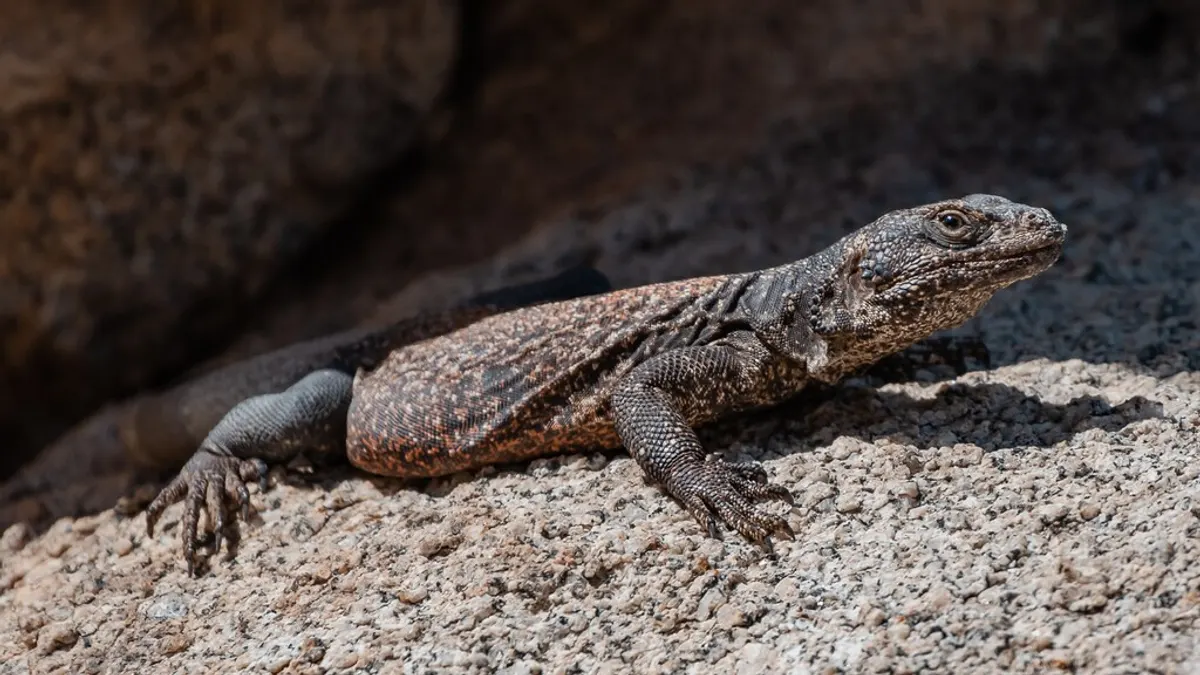
Cover photo: Common chuckwalla by Joshua Tree National Park, Public Domain Mark, via Flickr. Cropped.
Related guides
Reptile Temperature and UVB Chart: Basking, Day and Night Temps for 59 Species
A searchable chart of 59 lizards, snakes, tortoises and turtles: basking surface, daytime and night temperatures, UVB zone and, where Merck covers them, humidity and diet.
Best Reptile Heat Lamps of 2026: Halogen, Deep Heat and Ceramic
Basking lamps for daytime heat and light-free heaters for night, chosen on the makers' specs and fixture requirements.
Best Reptile Heat Mats of 2026: Under Tank Heaters Compared
Under tank heaters compared on size, wattage and the makers' mounting rules, plus why each needs a thermostat.