
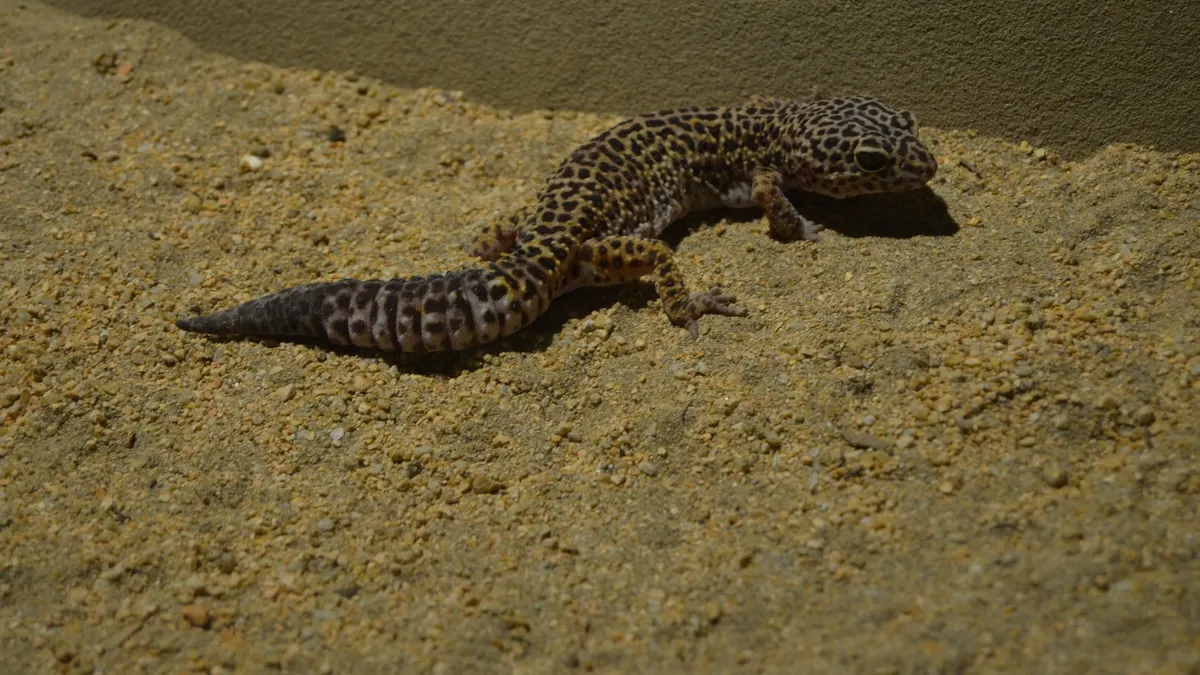
Leopard Gecko Enclosure Setup: Size, Heat, UVB and Hides
Affiliate disclosure: product links on this page go to Amazon, or to the maker's own store for brands that sell only direct. As an Amazon Associate we earn from qualifying purchases, at no extra cost to you; a link to a maker's store earns us nothing. No retailer or brand sees our picks before they are published or has any say in them. How we choose.
One adult leopard gecko needs an enclosure of at least 60 cm long, 40 cm high and 30 cm deep (24 x 16 x 12 inches) by the RSPCA's minimum, and a 36 x 18 inch floor is the more comfortable size. Heat one end to 28 to 30°C (82 to 86°F) with the other at 24 to 26°C (75 to 79°F), give it a low-level UVB gradient that tops out at a UV index of about 0.7, keep humidity around 30 to 40%, and provide hides at both ends plus a humid hide. Every heater runs through a thermostat. The figures below name their sources, and where VCA Animal Hospitals or the Merck Veterinary Manual differ, both are shown.
The setup at a glance
| What | Target | Source |
|---|---|---|
| Enclosure, one adult | 60 x 40 x 30 cm minimum (L x H x D), as large as possible | RSPCA |
| Enclosure, one adult | 10 gallon aquarium, at least 6 in high | VCA |
| Floor area | 0.2 square meters per 10 cm of total length | Merck Veterinary Manual |
| Warm (basking) zone | 28 to 30°C (82 to 86°F) | RSPCA |
| Basking surface | 32°C (90°F) | Baines et al. 2016 (UV-Tool) |
| Cage temperature | Mid-80s °F (about 30°C) | VCA |
| Cool end | 24 to 26°C (75 to 79°F) | RSPCA |
| Air temperature range (POTZ) | 25 to 30°C (77 to 86°F) | Merck Veterinary Manual |
| Night | Heat off unless the room drops below 18°C (64°F) | RSPCA |
| Night | Tolerates down to 70°F (21°C) | VCA |
| UV index | 0.7 at the basking zone, zero in the shade | RSPCA |
| Ferguson zone | 1 (crepuscular or shade dweller) | Baines et al. 2016 |
| Humidity | About 30 to 40% | RSPCA |
| Humidity | 20 to 30% | Merck Veterinary Manual |
Enclosure size
The sources are far apart here. VCA's care sheet, written by a veterinarian, says a single gecko "can be housed in a 10-gallon aquarium". The RSPCA's minimum is 60 cm long, 40 cm high and 30 cm deep, and it says the enclosure "should be as large as possible". The Merck Veterinary Manual gives 0.2 square meters of floor per 10 cm of total length for ground-dwelling lizards. VCA puts adults at 5 to 10 inches (12 to 25 cm), so Merck's figure is 0.24 to 0.5 square meters (2.6 to 5.4 square feet).
A 36 x 18 inch floor (4.5 square feet) meets the RSPCA minimum and Merck's figure for geckos up to about 21 cm. A 4 x 2 foot floor covers any adult. Height matters less for a ground dweller; 16 to 18 inches clears the RSPCA's 40 cm. Our best leopard gecko enclosures are sized against all three sources.
VCA warns that male geckos can be territorial; never house two males together.
Heat and the temperature gradient
The RSPCA describes two ways to heat one end:
- Overhead: a 60 to 100 watt ceramic or basking lamp at one end, on a dimming thermostat with the probe above the substrate, adjusted until the basking zone reads 28 to 30°C on a digital thermometer.
- Heat mat: a reptile heat mat on one side of a wooden vivarium, or under half the base of a glass one, on an on/off thermostat with the probe directly over the mat, set at 30°C.
The RSPCA puts it plainly: a thermostat "must be used with all heat sources". It also warns that thermostats are not always accurate, so check temperatures daily with a digital thermometer. VCA lists heat tape, under-tank heaters and low-level basking lights as good heat sources, says the gecko should not be able to get closer than 6 inches to a heat light, and warns that in-tank hot rocks create hot spots that can burn. See our heat mat guide and thermostat guide for matching the two.
At night the RSPCA turns the heat off, adding heat only if the room falls below 18°C, using a ceramic heat lamp (no light) on a thermostat set at 18 to 20°C. VCA says geckos tolerate night temperatures as low as 70°F (21°C). The UV-Tool paper by Baines and colleagues lists a summer night air range of 20 to 24°C (68 to 75°F) for the species.
UVB lighting
The sources differ on how much UVB a leopard gecko needs. VCA says UVB "is not required, but is recommended", with the lamp 10 to 12 inches from the gecko. The RSPCA asks for a 2 to 5% UVB tube, one half to one third of the enclosure's length, mounted in the roof, with a gradient from a UV index of 0.7 at the basking zone to zero in the shade. It notes that mesh partly blocks UVB, so a taller enclosure may need a stronger tube.
The 2016 UV-Tool paper puts leopard geckos in Ferguson zone 1, the shade dwellers, whose recommended UV index range is 0 to 0.7 with a maximum of 0.6 to 1.4 at the closest point to the lamp. It also cites a study in which leopard geckos given low-level UVB had vitamin D3 metabolite levels 3.2 times those of geckos given dietary supplements alone. Give a UVB gradient and a fully shaded hide, so the gecko chooses its own exposure. Our Ferguson zones guide explains how to measure it.
Humidity and the humid hide
Keep the enclosure dry: the RSPCA says leopard geckos need a relatively dry environment to prevent skin or airway problems, normally around 30 to 40% measured at the cool end. The Merck manual's table gives 20 to 30%.
Shedding needs moisture in one spot, not everywhere. The RSPCA's method is a hide with a waterproof bottom containing damp moss, sprayed with clean water every few days. VCA suggests wet sphagnum moss, cypress mulch or vermiculite to help with moisture and shedding.
Substrate
- The RSPCA suggests a mix of about 50% organic soil and 50% sand, using clean children's play sand or reptile sand, not sharp builders' sand. It rules out calcium sand, beech chips and other non-natural loose substrates.
- VCA lists reptile carpet, bark, paper towels or newspaper, and says never to use coarse sand, corncob bedding or crushed walnut shells, which can be swallowed and block the intestines.
Both rule out the same high-risk materials. If your gecko is young, thin or unwell, ask a reptile veterinarian before using any loose substrate. A soil mix can also be built as a bioactive layer.
Hides and furniture
The RSPCA asks for several hides at both ends so the gecko can choose its temperature, plus the humid hide. That means at least three: a warm hide, a cool hide and the humid hide. Add flat rocks and a low branch for climbing. Our hide guide compares caves by size and material.
Shopping list
| Item | What to look for | Example |
|---|---|---|
| Enclosure | 36 x 18 in floor or larger, front opening | Phailozoo 50 Gallon 36x18x18 |
| Heat mat (glass enclosure) | Covers about half the floor, on an on/off thermostat | BN-LINK 8 x 12 in heat pad, 16W |
| Thermostat | On/off for a mat, dimming for a lamp | BN-LINK Digital Heat Mat Thermostat (on/off) |
| Overhead heat (PVC enclosure) | Low-wattage halogen or ceramic, on a dimming or proportional thermostat | Arcadia Halogen Heat Lamp, 35W |
| UVB | Low-output tube (the RSPCA says 2 to 5%), one half to one third the enclosure length | Zoo Med ReptiSun T5 HO Hood with 5.0 Lamp, 14 in |
| Thermometer and hygrometer | Digital, one at each end | Govee H5075 |
| Dry hides | Two, one at each end | Exo Terra Gecko Cave, Medium |
| Humid hide | Waterproof base, room for damp moss | Zoo Med Repti Shelter 3-in-1 |
Setup checklist
- Set the enclosure on a level surface that takes its full weight with substrate.
- Fit the heat source at one end and wire it through the right type of thermostat.
- Mount the UVB tube in the roof over the warm end, covering one half to one third of the length.
- Run the empty enclosure for a few days and adjust until the warm zone reads 28 to 30°C and the cool end 24 to 26°C.
- Add substrate, a hide at each end and the humid hide with damp moss.
- Put the hygrometer at the cool end and check humidity sits around 30 to 40%.
Spot clean waste as it appears and do a full clean monthly, as the RSPCA recommends; our cleaning guide covers safe disinfectants. Diet and supplements are beyond this guide; ask a reptile veterinarian.
Frequently asked questions
What temperature should a leopard gecko tank be?
The RSPCA gives 28 to 30°C (82 to 86°F) at the warm zone and 24 to 26°C (75 to 79°F) at the cool end. VCA says leopard geckos do best in the mid-80s °F, and the Merck Veterinary Manual's range is 25 to 30°C (77 to 86°F). Control the heater with a thermostat and check with a digital thermometer.
Do leopard geckos need UVB?
VCA says UVB is not required but is recommended. The RSPCA asks for a 2 to 5% UVB tube giving a UV index of 0.7 at the basking zone and zero in the shade. The 2016 UV-Tool paper puts leopard geckos in Ferguson zone 1 and cites a study where geckos given low-level UVB had higher vitamin D3 levels than geckos on diet alone.
Should I use a heat mat or a heat lamp for a leopard gecko?
Either works. The RSPCA describes a 60 to 100 watt ceramic or basking lamp on a dimming thermostat, or a heat mat under half the base of a glass vivarium on an on/off thermostat set at 30°C. Whichever you choose, it must run through a thermostat.
What humidity does a leopard gecko need?
The RSPCA says around 30 to 40%, measured at the cool end, and warns that a damp enclosure can cause skin or airway problems. The Merck Veterinary Manual gives 20 to 30%. Moisture for shedding goes in a humid hide with damp moss, not the whole enclosure.
Do leopard geckos need heat at night?
The RSPCA turns the heat off at night unless the room drops below 18°C (64°F), and then uses a non-light ceramic heater on a thermostat. VCA says leopard geckos can tolerate night temperatures as low as 70°F (21°C).
How many hides does a leopard gecko need?
The RSPCA asks for several hides at both ends so the gecko can pick its temperature, plus a humid hide with damp moss. That means at least three: warm, cool and humid.
Sources
- How To Care For a Leopard Gecko, RSPCA
- Leopard Geckos: Care and Feeding, VCA Animal Hospitals
- Management and Husbandry of Reptiles, Merck Veterinary Manual
- How much UV-B does my reptile need? The UV-Tool, a guide to the selection of UV lighting for reptiles and amphibians in captivity, Journal of Zoo and Aquarium Research
Cover photo: common leopard gecko, leopardgecko, pakistanischer fettschwanzgecko, spotted fat-tailed gecko by Nico Hernandez, CC BY 4.0, via inaturalist. Cropped.
Related guides
Ball Python Enclosure Setup: Size, Heat, Humidity and Hides
Length to match the snake, a 30 to 32°C warm end, 50 to 60% humidity and tight, dark hides at both ends: the ball python setup with its sources.
Bearded Dragon Enclosure Setup: Size, Heat, UVB and Substrate
A 4x2x2 minimum, a 100 to 108°F basking spot, a UV index of 3 to 5 under the lamp and a dry cool end: the setup, figure by figure, with sources.
Best Bearded Dragon Enclosures of 2026: 4x2x2 and Bigger
A 4x2x2 is the floor for one adult bearded dragon. These are the enclosures that meet it, and the ones that go past it.