
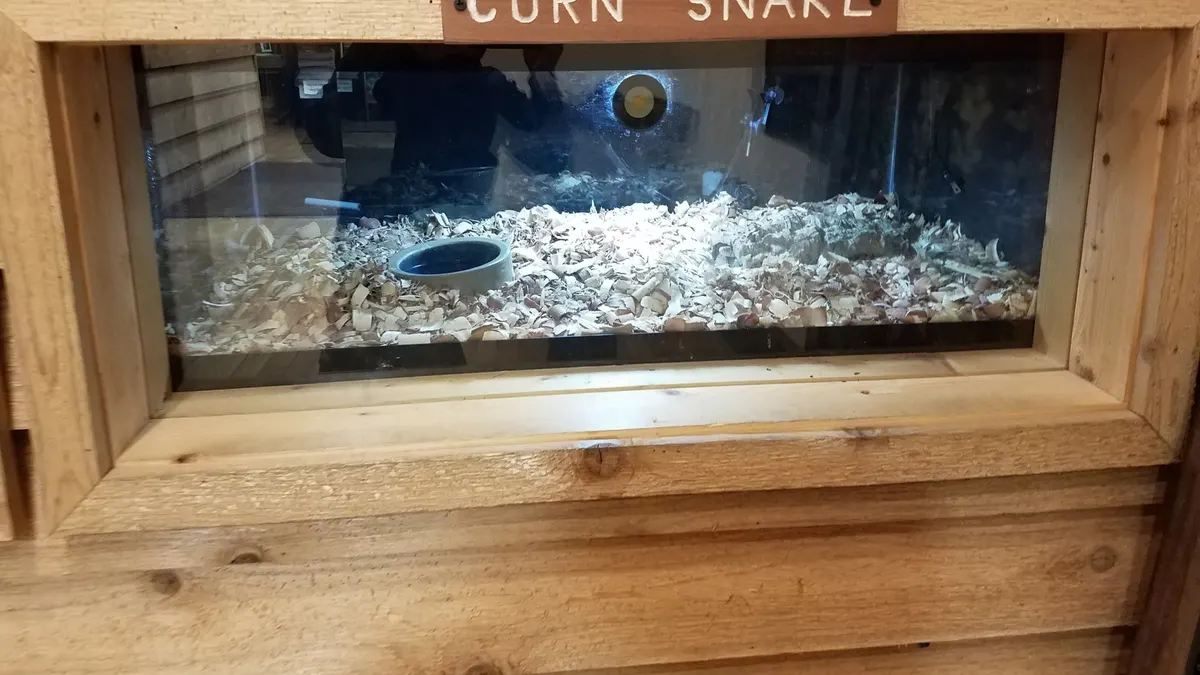
Corn Snake Enclosure Setup: Size, Heat, UVB and Hides
Affiliate disclosure: product links on this page go to Amazon, or to the maker's own store for brands that sell only direct. As an Amazon Associate we earn from qualifying purchases, at no extra cost to you; a link to a maker's store earns us nothing. No retailer or brand sees our picks before they are published or has any say in them. How we choose.
An adult corn snake needs an enclosure of at least 48 x 24 x 24 inches, the minimum used by the Royal Veterinary College's exotics service, and the RSPCA's rule (length equal to the snake's, width and height a third of it) asks for about 5 feet of length for a 5 foot snake. Heat one end to 28 to 30°C (82 to 86°F) with the cool end at 20 to 24°C (68 to 75°F), keep humidity around 40 to 60%, give low-level UVB, and put a hide at each end of an escape-proof enclosure. Every heater runs through a thermostat. Where the sources disagree, most of all on night temperatures, both figures are shown.
The setup at a glance
| What | Target | Source |
|---|---|---|
| Enclosure, adult | 48 x 24 x 24 in minimum | RVC Beaumont Sainsbury Animal Hospital |
| Enclosure, adult | Length equal to the snake's; width and height one third of it (150 cm snake: 150 x 50 x 50 cm) | RSPCA |
| Floor area | 0.6 square meters per meter of snake (rat snakes and kingsnakes) | Merck Veterinary Manual |
| Adult length | 4 to 6 ft (1.2 to 1.8 m) | VCA |
| Adult length | Up to 150 cm (5 ft), usually within 5 years | RVC |
| Warm (basking) zone | 28 to 30°C (82 to 86°F) | RSPCA |
| Basking | About 30°C (86°F) | RVC |
| Cool end | 20 to 24°C (68 to 75°F) | RSPCA |
| Housing temperature | 25 to 30°C (77 to 86°F) | VCA and Merck Veterinary Manual |
| Night | Can drop to 16 to 20°C (61 to 68°F) | RSPCA |
| Night | Not below about 24°C (75°F) | RVC |
| UV index | 1.0 at the basking zone, zero in the shade | RSPCA |
| Ferguson zone | 1 to 2 | Baines et al. 2016 (UV-Tool) |
| Humidity | About 40 to 50% | RSPCA |
| Humidity | 50 to 60% | RVC |
| Humidity | 30 to 70% | Merck Veterinary Manual |
Enclosure size
The RVC says hatchlings start around 20 cm (8 inches), reach about 60 cm (2 feet) in their first year and can reach 150 cm (5 feet), usually within 5 years. VCA gives adult lengths of 4 to 6 feet with good diet and housing.
The RVC recommends a minimum of 48 x 24 x 24 inches so the snake can stretch out, and says wooden or fiberglass enclosures are ideal because they give the snake visual security. The RSPCA uses the snake's own length: a 150 cm corn snake needs at least 150 cm long, 50 cm wide and 50 cm deep. The Merck Veterinary Manual gives 0.6 square meters of floor per meter of snake, or 0.72 to 1.08 square meters (7.8 to 11.6 square feet) for a 1.2 to 1.8 meter adult.
| Enclosure | Floor area | Meets RSPCA rule up to | Meets Merck figure up to |
|---|---|---|---|
| 4 x 2 x 2 ft | 8 sq ft (0.74 m²) | 4 ft snake | About 1.24 m (4.1 ft) snake |
| 5 x 2 x 2 ft | 10 sq ft (0.93 m²) | 5 ft snake | About 1.55 m (5.1 ft) snake |
| 6 x 2 x 2 ft | 12 sq ft (1.11 m²) | 6 ft snake | About 1.86 m (6.1 ft) snake |
A hatchling can start smaller: the RSPCA mentions a smaller enclosure heated by a mat for hatchlings. Every snake enclosure must be escape-proof, with sealed seams and a locking top, according to VCA's snake housing sheet. Corn snakes also climb, and the RVC suggests sturdy branches. Our size guide and PVC enclosure picks cover the 4 to 6 foot sizes.
Heat and the temperature gradient
The RSPCA heats the basking zone to 28 to 30°C with the cool end at 20 to 24°C. The RVC uses a light-emitting spot or ceramic bulb for a basking temperature of about 30°C, on all day and off at night, with guards on every heater. For a small hatchling enclosure, the RSPCA uses a reptile heat mat under one side on an on/off thermostat with its probe at the hot end, set at 30°C. Both say a thermostat goes on every heat source; see our thermostat guide and heat mat picks.
Night is where the sources split. The RSPCA says the temperature can safely drop to 16 to 20°C at night. The RVC sets background heat so it does not fall below about 24°C. VCA's general snake sheet says heat is not necessary at night if the temperature stays at 65 to 70°F (18 to 21°C), and the UV-Tool paper by Baines and colleagues lists 20°C as the summer night air temperature for corn snakes. A night reading of 20°C (68°F) fits three of the four; check with a reptile veterinarian if your room runs colder than that.
VCA warns against hot rocks, which it calls dangerous and ineffective.
UVB lighting
The RVC says corn snakes appear to benefit from UVB despite being crepuscular, and recommends a low level for 12 hours a day at the distance the manufacturer gives, with a branch or rock under the basking site. The RSPCA asks for a low-output 2 to 7% UVB tube, one half to one third of the enclosure length, as far into the hot end as possible, giving a UV index of 1.0 at the basking zone and zero in the shade. The UV-Tool paper places corn snakes in Ferguson zone 1 to 2 and cites a study showing corn snakes make vitamin D3 in their skin under low levels of UVB from fluorescent lamps. VCA notes vets are divided on UV for snakes but says it is not harmful and may be beneficial.
Humidity
Moderate. The RSPCA gives about 40 to 50%, the RVC 50 to 60%, and the Merck manual's range is 30 to 70%. Measure with a hygrometer; the RVC raises humidity by spraying or by moving the water bowl. Around 50% satisfies all three.
Substrate
The RSPCA recommends organic soils or soil and sand mixes made for reptiles and says not to use sand alone, which can irritate the skin. The RVC lists aspen, orchid bark, wood chip and cypress mulch, with newspaper or paper towels for the short term. The RVC warns against feeding on loose substrate, which can be swallowed. VCA adds that cedar shavings are toxic to reptiles.
Hides
The RSPCA asks for at least two hides, one at each end, and the RVC agrees, listing artificial plants, cardboard boxes, plant pots, logs or commercial hides. A hide at each end lets the snake pick its temperature without leaving cover. Our hide guide lists snake caves by size.
Shopping list
| Item | What to look for | Example |
|---|---|---|
| Enclosure | 48 x 24 x 24 in or larger, locking doors, no gaps | Phailozoo 120 Gallon 4x2x2 or Reptile Habitats 5x2x2 |
| Basking heat | Guarded halogen or deep heat projector over one end | Arcadia Halogen Heat Lamp, 35W |
| Thermostat | Dimming or proportional for a lamp | REPTI ZOO Dimming Thermostat (TC02) |
| UVB | Low-output tube (2 to 7%), one half to one third the length | Zoo Med ReptiSun 5.0 T5 HO lamp, 22 in in a 24 in T5 HO fixture with reflector |
| Thermometer and hygrometer | Digital, one at each end, checked daily | Govee H5075 |
| Hides | Two, one at each end | Exo Terra Snake Cave and Zilla Rock Lair |
Setup checklist
- Check every seam, vent and cable hole; VCA says snake cages must be escape-proof with sealed seams and a locking top.
- Fit the guarded lamp and the UVB tube over one end; wire the lamp through the thermostat.
- Run the enclosure for a few days and adjust until the warm end reads 28 to 30°C and the cool end 20 to 24°C.
- Add substrate, a hide at each end, a water bowl and a sturdy branch.
- Check humidity with a hygrometer and aim for around 50%.
Spot clean waste as it appears and clean fully once a month with a reptile-safe disinfectant, as both the RSPCA and RVC advise; our cleaning guide covers products and contact times.
Frequently asked questions
What size tank does an adult corn snake need?
The Royal Veterinary College's exotics service recommends a minimum of 48 x 24 x 24 inches. The RSPCA sizes it to the snake: at least as long as the snake, with width and height a third of its length, so a 150 cm (5 foot) corn snake needs 150 x 50 x 50 cm or more.
Is a 20 gallon tank big enough for a corn snake?
Only for a hatchling or young snake. The RVC says corn snakes reach about 60 cm in their first year and up to 150 cm as adults, and its adult minimum is 48 x 24 x 24 inches. The RSPCA mentions smaller, mat-heated enclosures for hatchlings.
What temperature should a corn snake enclosure be?
The RSPCA gives 28 to 30°C (82 to 86°F) at the basking zone and 20 to 24°C (68 to 75°F) at the cool end. VCA and the Merck Veterinary Manual give 25 to 30°C (77 to 86°F) as the housing range. Control every heater with a thermostat.
Do corn snakes need heat at night?
The sources differ. The RSPCA says night temperatures can drop to 16 to 20°C, VCA says heat is not needed if it stays at 65 to 70°F, and the RVC keeps nights above about 24°C. A night reading around 20°C (68°F) fits three of the four sources.
Do corn snakes need UVB?
The RVC and RSPCA both recommend low-level UVB. The RSPCA asks for a 2 to 7% tube giving a UV index of 1.0 at the basking zone and zero in the shade. The 2016 UV-Tool paper places corn snakes in Ferguson zone 1 to 2 and cites research showing they make vitamin D3 under low UVB.
What humidity does a corn snake need?
The RSPCA says about 40 to 50%, the RVC 50 to 60%, and the Merck Veterinary Manual 30 to 70%. Around 50% satisfies all three.
Sources
- How To Care For a Corn Snake, RSPCA
- Corn Snake Care, Royal Veterinary College, Beaumont Sainsbury Animal Hospital
- Snakes: Colubrid, VCA Animal Hospitals
- Snakes: Housing, VCA Animal Hospitals
- Management and Husbandry of Reptiles, Merck Veterinary Manual
- How much UV-B does my reptile need? The UV-Tool, a guide to the selection of UV lighting for reptiles and amphibians in captivity, Journal of Zoo and Aquarium Research
Cover photo: eastern corn snake, gewöhnliche kornnatter, red cornsnake by Donna, CC0 1.0, via inaturalist. Cropped.
Related guides
Ball Python Enclosure Setup: Size, Heat, Humidity and Hides
Length to match the snake, a 30 to 32°C warm end, 50 to 60% humidity and tight, dark hides at both ends: the ball python setup with its sources.
Bearded Dragon Enclosure Setup: Size, Heat, UVB and Substrate
A 4x2x2 minimum, a 100 to 108°F basking spot, a UV index of 3 to 5 under the lamp and a dry cool end: the setup, figure by figure, with sources.
Best Bearded Dragon Enclosures of 2026: 4x2x2 and Bigger
A 4x2x2 is the floor for one adult bearded dragon. These are the enclosures that meet it, and the ones that go past it.